MeOW and welcome to Service Cats and Everything Feline. What do ya’ think about our new name? Anyways, we’re getting some great questions, so keep ‘em comin’. ‘Member, there’s no dumb questions. Even the experts can still learn somethin’. Mommy says the day you think you can no longer learn anythin’ more is the day you become a fool. You can ketch up any time on any of the posts in this series by clickin’ the Training Tips and Everything Feline link in our menu board above. Please leave your questions or post suggestions in the comments below or send us an email via our Contact Page from the menu above. We’re glad ya’ll enjoyed last weeks post and hope we simplified the definitions somewhat and made it easier to understand the difference in the classifications of our Animal Helpers.
The followin’ post will be written in human English fur reader and translator ease. Our Service Cat posts aren’t intended to be an all inclusive Trainin’ Manual but rather Tips, Tricks and Techniques used/developed by mommy A thru her many years of animal trainin’, cats in purrticular. And to offur insight into your questions about Everything Feline. Always remember, Training is all ‘bout Repetition and Rewards.
We were asked, “How long does it usually take to Train a kitty to perform a task?” Our general answer is going to be: Each kitty is different and there are a lot of factors that need to be considered when Training kitty; so the time it takes will vary. Any kitty can be Trained regardless of age, breed, “disabilities” or personality. Successful Training is always, always about Repetition and Rewards. Remember, when it comes to Training mommy says, “Learning doesn’t take a day off”. Mommy used to give piano lessons to humans of all ages. While most teachers give 30 minute a week lessons over the span of 10 years or more, mommy insisted on 1 hour a week lessons for 1 year without breaks or vacations. No summer’s off for mommy’s students. However, if they stuck it out, there’s nothing they wouldn’t be able to play, and in most cases could rewrite music into any key they wished in just minutes. Mommy is very serious about Training of any kind.
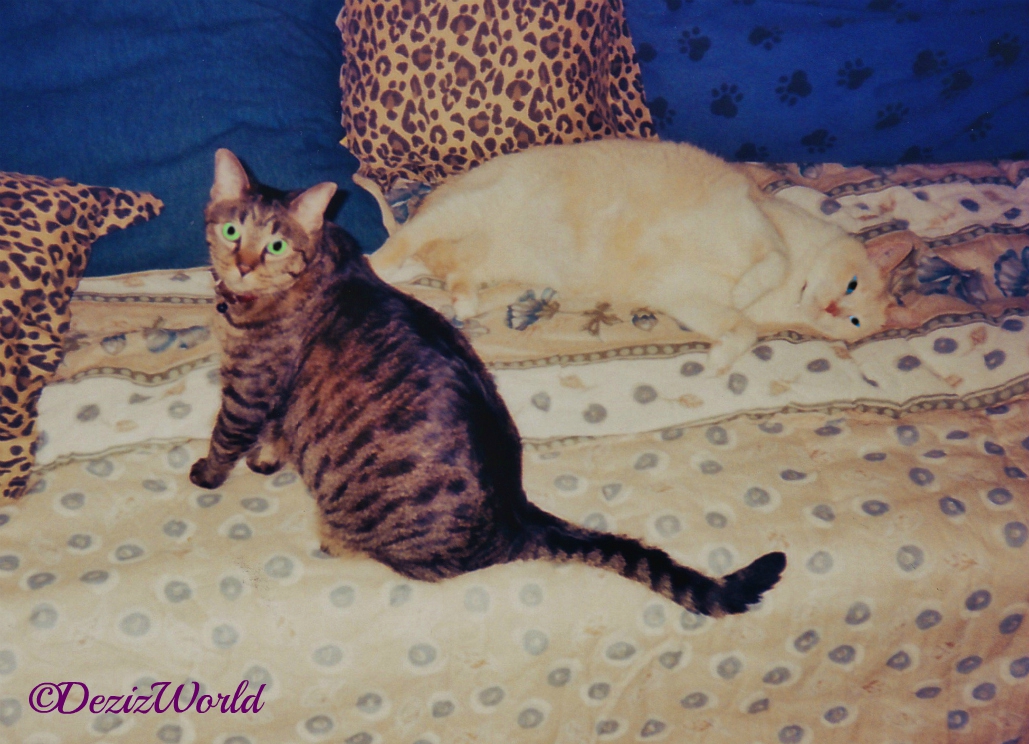
Shad (110 camera image)
That being said, let’s take a look back at some of the Service Cats mommy has Trained and how long it took to learn specific tasks. We’ll start with Shad, since she was mommy’s first Service Cat. If you missed Shad’s story, you can read it here. Shad actually Trained herself, but we can look at the sequence of events that occurred leading up to her first act of calling 911 for help. Mommy’s accident occurred in November. A lot of her problems were immediate including passing out. Shad’s first Service Cat act was to dial 911 on the telephone when mommy passed out and hit her head on an end table. She did this in March of the year following mommy’s accident. Mommy surmised that Shad had been observing her since November and realized that when mommy hit her head she was out longer and often more confused when she came too. The next task Shad taught herself was to move the shower curtain away from mommy’s face and push mommy’s head away from the water flow when she passed out in the shower. She first did this in April following the accident. Again, mommy surmised after receiving praise for her attempts to get mommy help, Shad stepped it up and wanted to do more to help. Shad was a small girl, weighing in at only 12 – 15 pounds on average, so she did the best she could considering mommy’s weight and size.
Now let’s move to a Service kitty most of you are familiar with and one that mommy did Train, Lexi. Mommy determined that if Shad could learn those things on her own, then surely mommy could teach other cats to perform those tasks as well as others. When Training, one must always keep in mind the size and natural instincts and abilities of the animal being Trained. For example, you can’t ask or expect a kitty of 6 pounds to pull a manual wheelchair. You must have realistic expectations to be successful in your Training attempts. Since all kitties have the ability and desire to “knead”/”make biscuits”, Massage is one of the first tasks mommy Trains a kitty to perform. Even the smallest of kitties has some power in those paws. After all, that’s how they work more milk into the mother cat’s teats. Lexi’s mother had been killed while she was giving birth, so mommy had raised her from the beginning. Even tho’ Lexi didn’t have to “work” for her milk, she still had great kneading capabilities. The trick here is teaching kitty when and where to knead/massage and how not to use their claws. You can read mommy A’s Training Tips here. A kitten’s eyes and ears are open by the age of 3 weeks, and that’s when mommy started Training Lexi. Lexi was successfully giving mommy massages on demand by the age of 5 weeks. Only occasionally would she get over excited and bring out her claws. Please Do Not Declaw Your Kitty, they can be trained not to use them on you but on appropriate surfaces!!!
Lexi at 6 months (110 camera image)
Mommy started teaching Lexi about the phone when she was about 7 weeks old. She learned the number pattern to dial in about a month but wasn’t big enough or heavy enough to actually push the buttons down until she was about 4 months old. We know it’s hard to believe, but sis Lexi was that small at one time. She had 2 brothers at the time who she watched help mommy in the shower every day. At about 4 months old, she jumped into the tub on her own and tried to help them. She was too small to make a difference, but she learned what to do by watching them and eagerly took her place beside them when she finally got big enough. Lexi was about 3 years old when mommy got her first wheelchair. At that time, Lexi and 1 brother, Lucky remained with mommy. They took turns learning about the wheelchair.
Lexi and Lucky laying on the bed. (110 camera image)
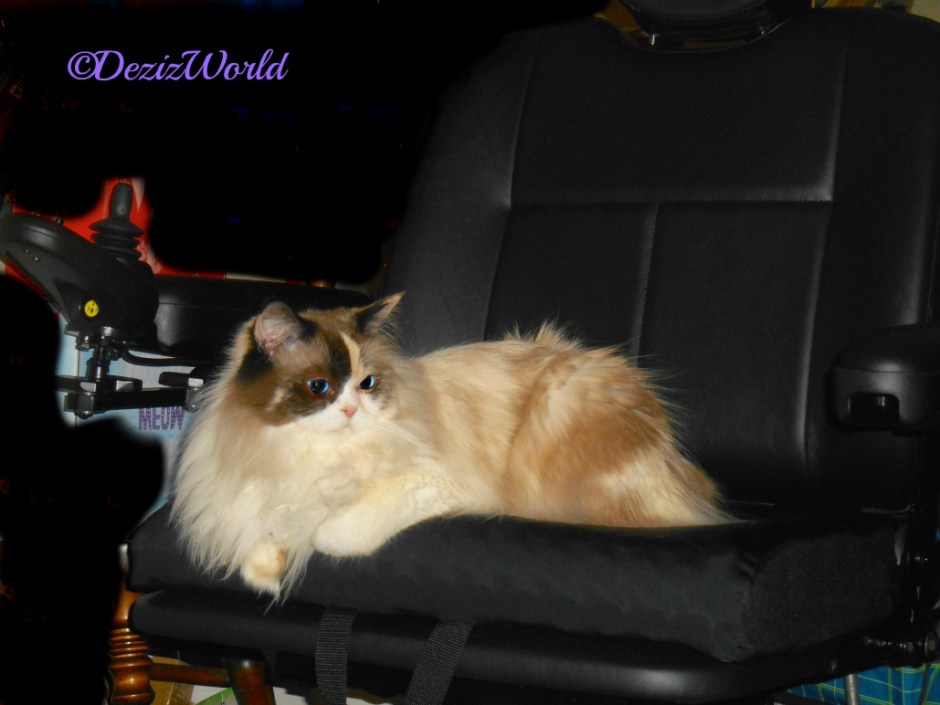
It took about 3 months before Lexi was comfortable enough around the chair to even ride in it. It was her brother Lucky that gave mommy the idea to train them to drive it. At the time, it was the only chair mommy had, so she sat in it most of the time. One night she and Lucky were relaxing in the chair watching television when he got up, pushed the power button, bit the joystick and propelled them forward. He seemed a bit shocked, but didn’t jump down. Lexi came running over and jumped up in mommy’s lap too. Mommy moved the chair back to where they had been and Lucky proceeded to repeat his actions. This happened over and over that night until mommy plugged the chair in and they went to bed. The next morning when mommy awoke, Lexi was sitting in the chair biting the joystick and trying to push it. A wheelchair will not operate when in charging mode.
Lucky laying in wheelchair (110 camera image)
We’re going to stop here for today. We’ll pick up where we left off next Friday, so be sure and stop by to see what’s next. And ‘member to leave your questions and post suggestions in the comments section below or send us an email via our Contact page. You can ketch up on any post you may have missed by clicking the links on our Training Tips and Everything Feline page from the menu above.
Meow and welcome to another installment of Service Cat Monday on Friday. We’re actually going to be changin’ the name to avoid any confusion. We also want to remind you that you can ketch up on any posts you may have missed by clicking on the Training Tips and Everything Feline link in our menu. Please send us your questions and topic suggestions in the comments below or via our contact form on our contact us page.
The followin’ post will be written in human English fur reader and translator ease. Our Service Cat posts aren’t intended to be an all inclusive Trainin’ Manual but rather Tips, Tricks and Techniques used/developed by mommy A thru her many years of animal trainin’, cats in purrticular. And to offur insight into your questions about Everything Feline. Always remember, Training is all ‘bout Repetition and Rewards.
We got a great suggestion on our last post, asking us to feature other Service Cats and their duties. We so wish we could do that, but, there aren’t many actual Service Cats out there. We only know of one other, and his person/handler doesn’t like to discuss her disability or what her kitty does for her. We have to respect her right to privacy. Mommy said she agreed to be open and honest about everything when we started our crusade to bring awareness to Service Animals other than dogs, but not everyone else did. That being said, if you know of or have a Service Cat of your own, please contact us so we can share your story. You can use the contact form on our contact page or the Training Tips page. You can also send us an email directly to: lexi.dezi@yahoo.com.
It’s a new year and we’ve gained some new followers, so we’d like to take today to remind everybody just what a Service Cat is. According to the ADA (Americans with Disabilities Act), a Service Animal is a dog that is individually Trained to do work or perform tasks for a person with a disability. There are no certifications or licensing’s required, nor is there any one place or government body overseeing the Training of such animals. Dogs and in some unique cases miniature horses are the only animals recognized as Service Animals that are afforded protections and rights under the law. The ADA definition doesn’t affect or limit the broader definition of Assistance Animal under the Fair Housing Act or the Air Carrier Access Act. That would be where our protections come into play.
A Service Animal, regardless of species is well behaved, comfortable in just about every situation and IS NOT a pet. There used to be an old saying, “Children should be seen and not heard” when in public and especially around a lot of adults. The same is true of Service Animals/Cats. A Service Animal isn’t bouncing off the walls, or barking/meowing, being a nuisance, playing or drawing attention to themselves or their handler. The exception would be if the Service Animal’s task is to alert others to it’s handlers’ situation (ie: handler is having a seizure and requires human assistance, etc.). A Service Animal stays beside their handler at all times and doesn’t pull at their leash or try to interact with other animals or humans while in public. They are not easily distracted. That’s why it’s so important to ask the Animal’s handler before interacting with/petting the animal. The Service Animal is “on duty” and is not a pet. Altho’ we think the “ask before petting” should be a rule about every animal one might encounter other than their own. Just because an animal looks cute, doesn’t give you the right to approach him/her without getting permission from the owner first.
There seems to be a lot of confusion about Service Animals, Therapy Animals and Emotional Support/Companion Animals. These three titles describe three completely different classes of animal and should not be confused with one another. We’ve given you the definition of a Service Animal and now we’ll define the Therapy animal and ESA (Emotional Support/Companion Animal.
Therapy Animal:
This is probably the most recognized of the classifications and often gets confused with the Service Animal. A Therapy Animal is an animal (any species) that has been Trained to provide comfort and affection to people (other than their own humans) in hospitals, retirement facilities, schools and other such places. You might be asking what kind of Training is required to make an animal “provide comfort”. Truth is, this Training is more for the human handler than the animal. An animal chosen to be a Therapy Animal is one that is outgoing, comfortable with people and in a variety of situations, calm, and generally well behaved. Training teaches the handler how to prepare the animal (grooming, bathing, etc.) to go into these places and who/how to contact to set up visits in these places. Certification is required for Therapy Animals. If you think you have an animal that would make a good Therapy Animal, check with your shelter or the ASPCA about classes. But, a Therapy Animal Is NOT a Service Animal.
Emotional Support/Companion Animal:
The Emotional Support animal is any PET that provides health benefits to a person. That’s pretty much all animals. There’s no Training required nor any certifications. This group is growing as more and more people move into homes/apartments requiring rental assistance. Usually pet deposits./fees are waived for those who can get their doctor to write a letter stating they require their animal for emotional support. These animals ARE Pets and NOT Service Animals. This classification comes with no rights, protections or privileges under the law other than that of personal property.
The bottom line here is that all animals are special and give health benefits to their owners. But, not all animals can be called Service Animals. Mommy says we’re the most special kitty girls on the planet, but not any more special than the kitty or doggy that lives with you and gives you joy, comfort and love. We just help mommy in a different way. We still provide her with joy, comfort and lots of love, but we’ve been individually and specifically Trained to perform certain tasks that help her to live independently. We’ll be talking more about those things soon. We’ve been asked some questions that we thought we had already answered, but again, we’ve had quite a few new followers. Mommy says it never hurts to tell something again just in case it was missed the furst time. So join us here each Friday for a look into our lives as Service Cats and answers to your questions about everything Feline. Purrlease leave your questions in the comments or send us a message via email on our Contact us page. And don’t furget, you can check out all the posts in this series by visiting our Training Tips page. And let us know ifin you know a Service Cat. We’d luv to meet them and share their story with everypawdy.
MeOW and welcome to our first Service Cat post of 2018. We’ve been chompin’ at the purr-verbial bit to get started. Me wants to point out a few changes we’ve made in an attempt to make these posts easier to find, and easier for you to ask questions. First, take a look at our menu options. We created a whole page with the links to every post in this series called Training Tips and Everything Feline. We will be adding descriptive tags so that you can easily find exactly what you’re looking for. We had hoped to have that done already, but as most of you know, we’ve had a few challenges keeping us busy elsewhere. Rest assured we will be doing that in short order. You will also find a contact form on the page that is completely private. Just fill it out with your questions or post suggestions and we’ll receive an e-mail readable only by us. If you’ve missed any posts in our Service Cats series, you may check this page to get all caught up. As Always you may continue to ask questions in the comments of our posts; we luv, luv, luv hearing from you. Remember when asking behavioral questions to purrlease be as specific as pawssible. Let’s get the business outta the way and get this pawrty started.
The followin’ post will be written in human English fur reader and translator ease. Our Service Cat posts aren’t intended to be an all inclusive Trainin’ Manual but rather Tips, Tricks and Techniques used/developed by mommy A thru her many years of animal trainin’, cats in purrticular. And to offur insight into your questions about Everything Feline. Always remember, Training is all ‘bout Repetition and Rewards.
We had a lot of questions last year regarding the new PowerChair/WheelChair. Just in case you’re new to our blog, let me explain. Mommy’s PowerChair broke last June. One of the motors went out and the chair wouldn’t do anything but turn in a circle. Being over five years old, Medicare wouldn’t pay to repair it; so, we had to go thru the procedures to get a new one. Unfortunately, that process is long and tedious. We finally got approved and received our new PowerChair in January of this year. Here are some of the questions ya’ll asked about the new PowerChair and our Training/Ability to use it:
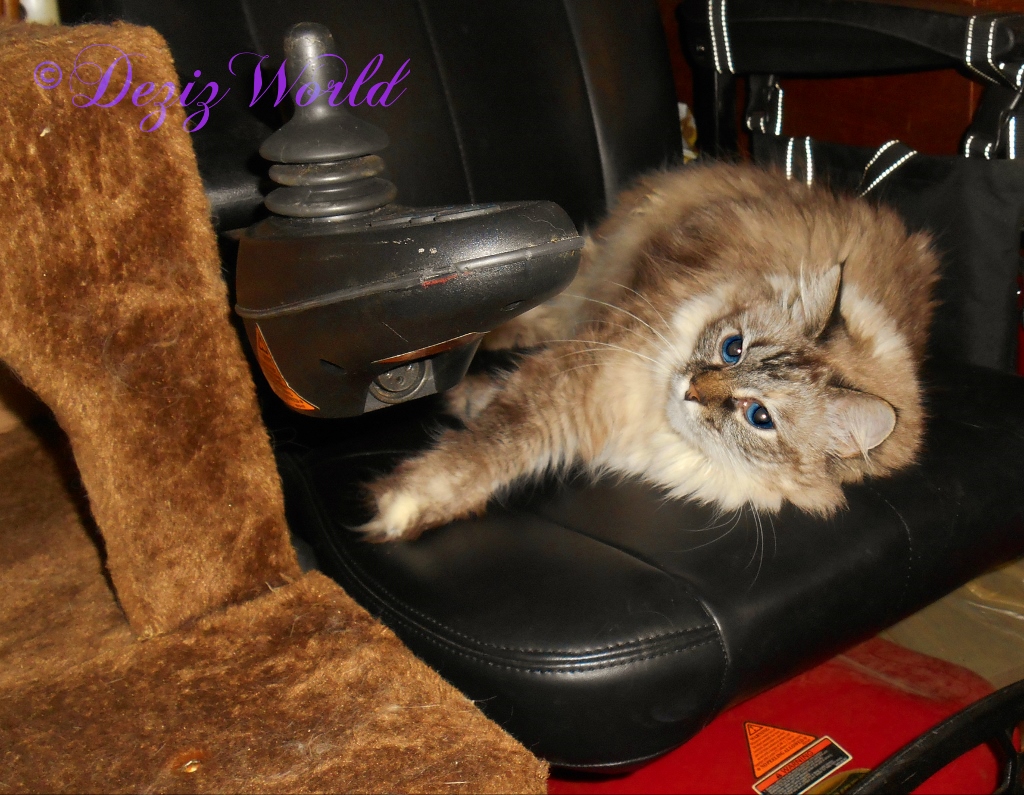
Old chair, but the joystick is the same on most chairs. It’s made of a
flexible rubber type material.
Q: Isn’t the joystick hard on a cat’s teeth?
A: The joystick is covered in/made of a fairly soft rubberized material, so it’s not any harder on a cat’s teeth than many of our toys.
Q: Does a repairman come out and evaluate the chair, and what steps are required to get a new PowerChair?
A: Yes, a repairman comes to our home to determine what’s wrong with the chair and if it can be fixed. If a PowerChair is over 5 years old, Medicare will not pay for repairs. So, the repairman must take measurements for a new PowerChair. The measurements required are the length of a persons arms, legs and torso. Measurements are also taken of the person’s width between the arms and weight. Other questions that will be asked is if the person has problems with incontinence, diabetes, ulcers or sores on their hiney, and the width of all doors and hallways in the home. Once those measurements are taken, the repairman will submit a request for a prescription from the person’s doctor. The person, (ie: mommy), must then see the doctor for a mobility evaluation, as well as a physical therapist. They will submit their evaluations along with a prescription to the PowerChair repairman who will submit it to Medicare for approval. The approval process can take as long as a year. There are emergency situations that can speed up the process, but it’s always best to expect a bit of a wait.
Q: Does the new PowerChair come with instructions or do we just have to figure it out ourselves?
A: The new PowerChair comes with a packet that explains how to assemble the chair and connect the control panel to the batteries as well as a description of the control panel. A small booklet with care instructions is also included. There’s no instructions on how to drive, which is why mommy ran into everything the first time she powered up.
Q: Why does it take so long to get a new PowerChair and do we have a manual chair we can use in the meantime?
A: We don’t know why it takes so long, but if you ever figure it out, let us know. MOL As for a manual chair, the answer is NO. Medicare and most insurance companies “rent” equipment in a succession based on health. That simply means they start with things such as canes and walkers and move up. Mommy skipped the manual wheelchair step because certain movements required to power a manual chair would cause her to pass out. She went straight from a cane to a PowerChair. So, when it’s broken, she’s left to get around however she can. In her case, that means crawling for several hours a day.
Q: Once the new PowerChair arrives, are we able to drive it or does it require re-Training?
A: Quite a few of you asked this question; but, until the new PowerChair got here, we couldn’t know for sure how to answer it. This is mommy’s third PowerChair, and each have been a little different. The first and second chair rode and drove pretty much the same and required no additional Training. Our new PowerChair however, rides and drives much differently than the previous chairs. The differences are subtle, but they are there. Enough so, that we will both require some new Training. Actually, me should say all three of us need some additional Training. The first time mommy powered on, she ran into everything and even fell off the sidewalk outside.
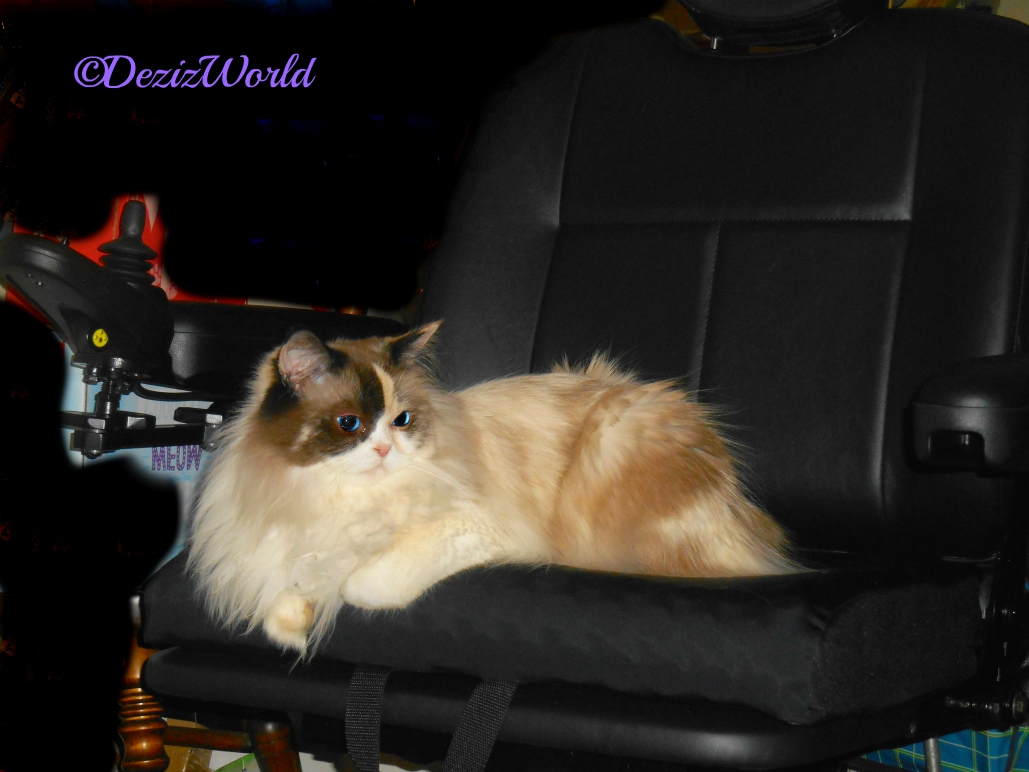
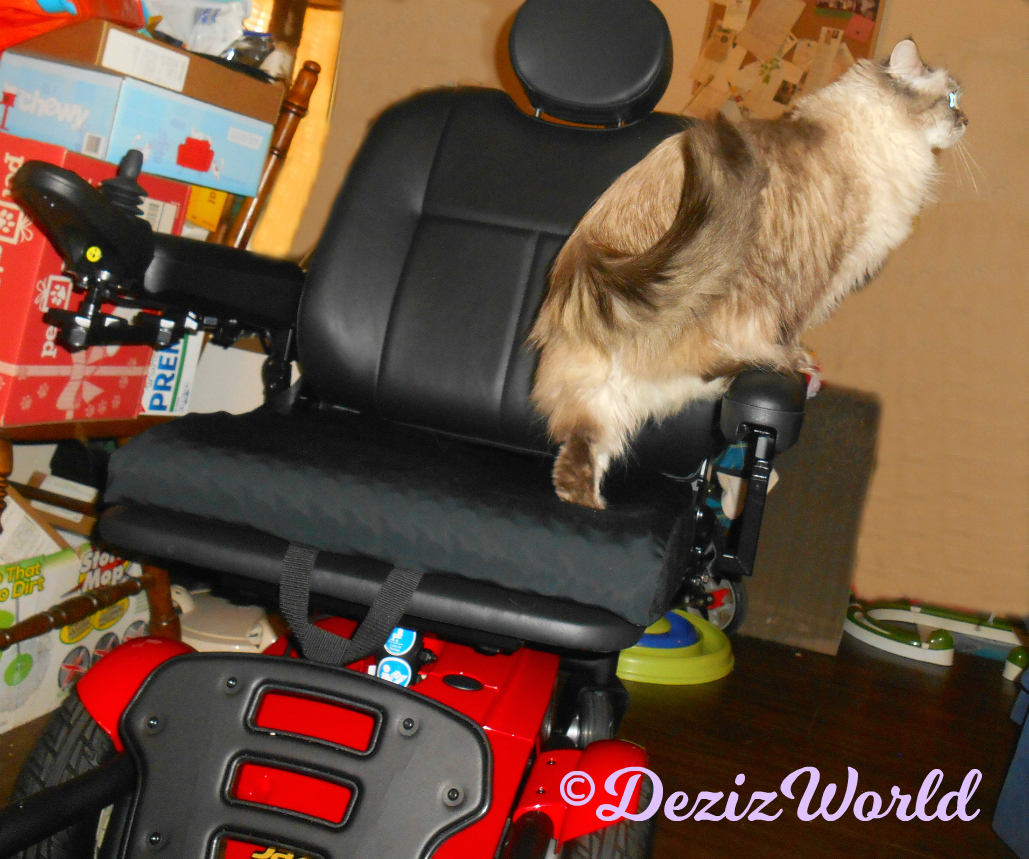
The view seems better from the new chair. And, the arms seem wider.
What are those differences, you ask? Well, for starters, the old chairs had a 360° turn without moving forward or backwards. The new PowerChair moves slightly forward when turning to the right, and slightly backwards when turning to the left. That may not sound like much to you, but due to limited space in our apartment, it can mean the difference in successfully turning around or hitting doors and walls and any other furniture that might be near, as well as falling off the curb. We have a very small kitchen and bathroom, so turning around becomes difficult in this chair. We’ll be doing more “backouts” instead of actual turning around. Mommy also says this joystick is very touchy. One little push or pull and the PowerChair starts moving. Altho’ that’s a good thing, it’s not something we’re used to and will require a few hours of additional Training. After all, we are cats and do find ourselves occasionally re-scenting the joystick with a little face rub. We for sure don’t want to go wheeling through the wall just because we showed the joystick some love. MOL The speed control on the new PowerChair is a dial up instead of a push button. Mommy hasn’t decided yet if that’s a good thing or not, but we’ll keep you posted as we go along. One small detail that others wouldn’t have given a second thought, is that the power button and horn are in the opposite positions from any chair we’ve ever owned. And the back wheels not only touch the floor all the time, they’re also the same size as the front.
So, a lot of little changes mean a lot of extra Training. Remember, altho’ the old chair was broken, we still had some form of Training each day, we just didn’t move. Getting used to moving again, is going to take a little time. However, mommy’s confident we’ll be ready for the races in no time. 🙂
Well, we hope we’ve answered the questions you all had about the new PowerChair. We’ll be posting more about our Training as well as tackling any other questions ya’ll might have. ‘Member, there are no stupid questions. Ifin you’ve been wanderin’ somethin’, you can rest assured you’re not alone. And be sure to check out our menu pageTraining Tips and Everything Feline to get caught up on any post you may have missed in this series.
We have a favor to ask. As you all know, we really want to go to BlogPaws this year. It’s a state over in Missouri. That’s just too close to miss, we think. Anyways, it’s time to submit your favorite blogs fur the Nose to Nose Awards. We fur sure would luv to be recognized and receive one of those pawsum awards. We’d really appreciate your nomination of our blog fur one or more categories. We’ve tried to make this as easy for you as pawssible, so, you can just do a copy and paste of the links. Here’s the categories we qualify for and the information you’ll need to submit us. Purrlease take a couple of minutes and fill out the form here. Fank you all so very much.
Best Written Pet Blog Post: Use the links above, unless you think another post was our best. If you choose another post, purrlease let us know which post you nominated. You may nominate more than one post or blog, it just has to be on a new form. Posts that are qualified for nomination/consideration: Any post created/published between January 2017 through February 2018.
Best Photo on a Pet Blog: We had a lot of trouble trying to narrow this one down. Purrlease feel free to choose one of the following, or you may choose any other foto of us on our blog:
We really ‘purreciate ya’ll takin’ the time to nominate us. If you’ve chosen a post or foto different from the links we provided, just let us know. We’re always innerested in knowin’ what you luv ‘bout us or our blog.
MeOW and welcome to an unService Cat Monday on Service Cat Monday. Which, due to technical difficulties beyond our control is wayyyyyyyy late. Now that was a mouthful wasn’t it? Anyways, fur mommy’s sanity and to furee up some time, Service Cat Monday question and answer and Training tips will resume in the new year. Altho’ mommy did say that our posty today could actually qualify as a Service Cat Monday posty. So, fur that reason, the followin’ will be in human English fur reader and translator ease. Actually, mommy will be doin’ most of this posty herself. But, you know Raena and me have to have our own meows ‘bout everythin’, so we’ll be includin’ our 2 cents too. Fur now, mommy, take it away.
Disclaimer: This is a Sponsored post. We received the Litter Robot Open Air III in exchange for our honest opinion. As always, we tell it like we see it and only bring products we feel would be of interest to you, our readers and friends.
Thank you baby. As you all know this blog is all about the girls. And, as special as they are, there are still things they can’t do and require a human touch. Most of you know that I’m disabled and need help with a few things. Let me give you a little back story before we proceed. Dezi came to me as a very sick little girl at the age of 2 1/2 – 3 weeks old. She had one of the worst cases of tape worm I’d ever seen in a kitten her size. And, with all that baby fine fur, the diarrhea, and the worms exiting her little body were constantly getting stuck to her bloomers. My response was to clean the litter box and her every time she exited. I must say, it was definitely the right thing to do, but it had lasting consequences. Long after the worms and diarrhea were gone, Dezi expected me to clean the litter box the minute it got used. As far as she’s concerned, we could have 10 boxes and she would still want the one that was used to be cleaned.
When you think about it, it actually makes perfect sense. I mean, would you want to use a toilet that hadn’t been flushed after it’s last “visitor”? So, as much of a chore scooping might be, I didn’t really give it a second thought. But, c’mon now, all of us kitty parents know the litter box is probably our least favorite thing about being owned by cats. As I get older and my health declines, scooping at certain times of the day gets more difficult. And with the wheelchair broken, getting to the box first thing in the morning is almost impossible. That brings us to today’s topic, Automated Litter Boxes. If you missed our post about Litter Boxes, Litter and Feline Urinary habits, you can catch up by clicking here.
Yep, that’s the right litter this time mommy.
Automated litter boxes have been around for quite some time now. So, I began my search for the “purrfect” automated box that could meet all the needs the girls have and still work for me and my budget and ideals. Ideals being no clay litters. As a Vet Tech I’d seen too many kitties come in with blockages from clay litter, to be comfortable using it especially with long haired cats that get it stuck to their bloomers. That right there, made it almost impossible for us to use one of those automated raking systems. Not to mention the actual box size available for kitty to do their business. But, today’s not about the “bads” of certain boxes, but rather the good and bad of the automated litter box we chose.
After much research, reading reviews, watching videos, and studying how and why the equipment works, we decided on the Litter Robot Open Air III. Now I’ll be honest, it wasn’t until I could actually see a video up close that I decided this was a good product. My initial thoughts were that the litter must end up in the top of the box since it rotates around to empty itself. With that thought, I couldn’t imagine why any cat would want to use it. After all, how would you feel if somebody pee’d or worse on your ceiling and you had to sit under that smell when you went to the bathroom? Thankfully, that’s not the case at all. you’ll see in the video below that the roof of the box stays free of dirty litter and smell. Before we get to the video, let me tell you what we were looking for in an automated litter box.
Covered: Raena occasionally still tries to swat Dezi’s tail when she’s in the litter box, so we have to have a covered litter box for privacy issues.
Size: Dezi is a large cat and Raena will be, so they need plenty of room to get in, turn around, stand, squat, dig and exit.
Works with almost any Litter: I’m not changing my mind and using clay litter, so the box we choose must allow for the litter we currently use: Swheatscoop and/or Garfield.
No Continued Expenses’ beyond electricity and inexpensive filters: Being on a fixed income means I can’t afford to by additional expensive boxes, special bags or trays.
Night Light: Yes I Know it sounds silly, but something happened to Dezi when our apartment flooded and she won’t go to the litter box in the dark.
Easy to Use: The girls must be able to enter and exit with ease.
Easy to Clean: Even the cleanest of kitties and “dustless” litter can eventually get any box a little dirty. But, due to my disabilities, handling and cleaning the size box the girls require must be easy.
Safe: The girls can sometimes get a little dig crazy and curious, so I don’t want anything around that could hurt or cut them.
Flexible Timer: Since Dezi will often pee and then need to poo almost immediately after, we need to be able to set a shorter timer than the traditional 15 minutes.
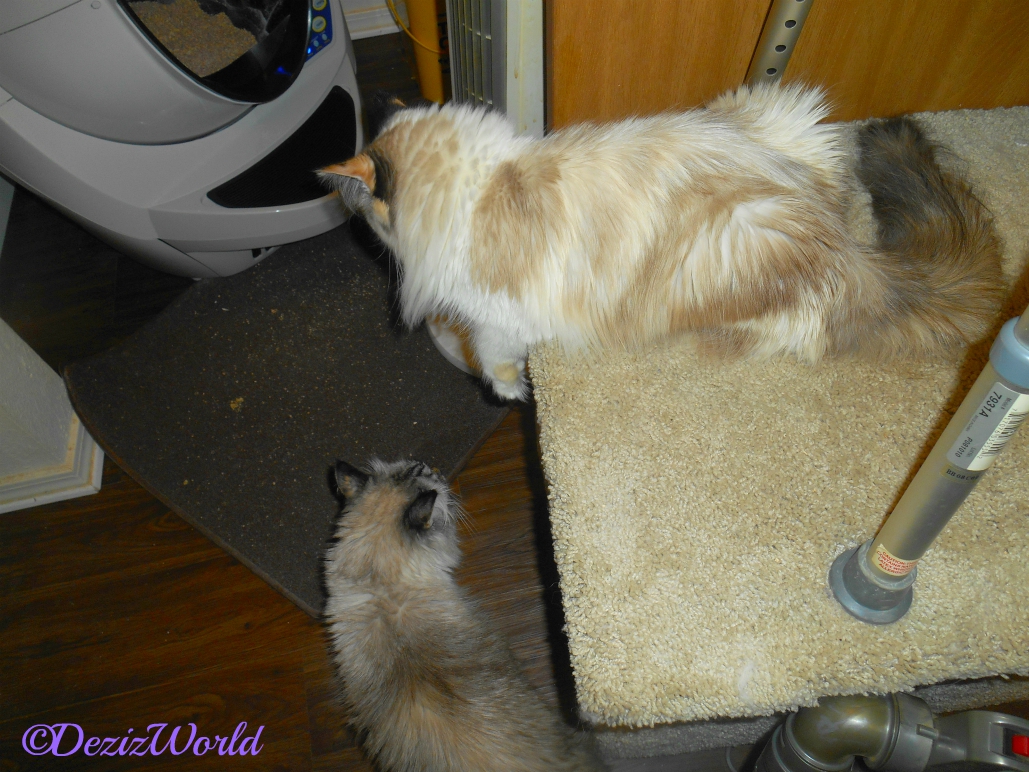
The Litter Robot Open Air III meets all our needs. If I had to say something negative, it would be about the Control Panel. As most of you know, the girls are Service Cats, and as such they are trained to turn on and off certain equipment. And, as a lot of you may recall, Raena’s been turning on all the power toys since she was about 8 weeks old. So, if I could, I would probably have a small door of some kind covering the buttons on the Control Panel. The thing is, there probably aren’t many other cats out there pressing the cycle button besides Raena; so I can’t really fault the Litter Robot peeps for not thinking about that.
They recently launched the Litter Robot Open Air Connect. If you already own a Litter Robot Open Air, you can purchase the upgrade equipment and install it yourself without voiding any warranty you may have or having to purchase a whole new system. The app connects your Litter Robot to your Apple iphone or ipad and allows you to monitor the waste drawer levels, usage and you could even trigger it to cycle if you have a kitty like Dezi that just peed and now needs to poo and can’t wait the 3 minutes.
The Litter Robot Open Air III sells for $449.00, with the Connect upgrade it’s $499.00. Trust me, I realize that’s a lot of money. I don’t make this recommendation lightly. But, after all the research I’ve done, and after having the unit in our home, I must say, the Litter Robot is worth every penny. The company sells replacement parts for the entire unit, so that you can replace only what may break or wear out in the future. They do sell reconditioned parts and units as well, so that may be another avenue to consider. Yes, it’s an investment, but, aren’t your cats worth it? Aren’t you worth it? As cat owners, most of us scoop the litter box without even thinking about it, but it’s really nice not having too. I definitely give the Litter Robot Open Air III 2 thumbs up. I’ll let the girls tell you how they feel.
Fanks mommy. Me luvs PB. It’s pawsum to always have a clean pawtty no matter the time of day or what you might be doin’. It’s an all paws up from me.
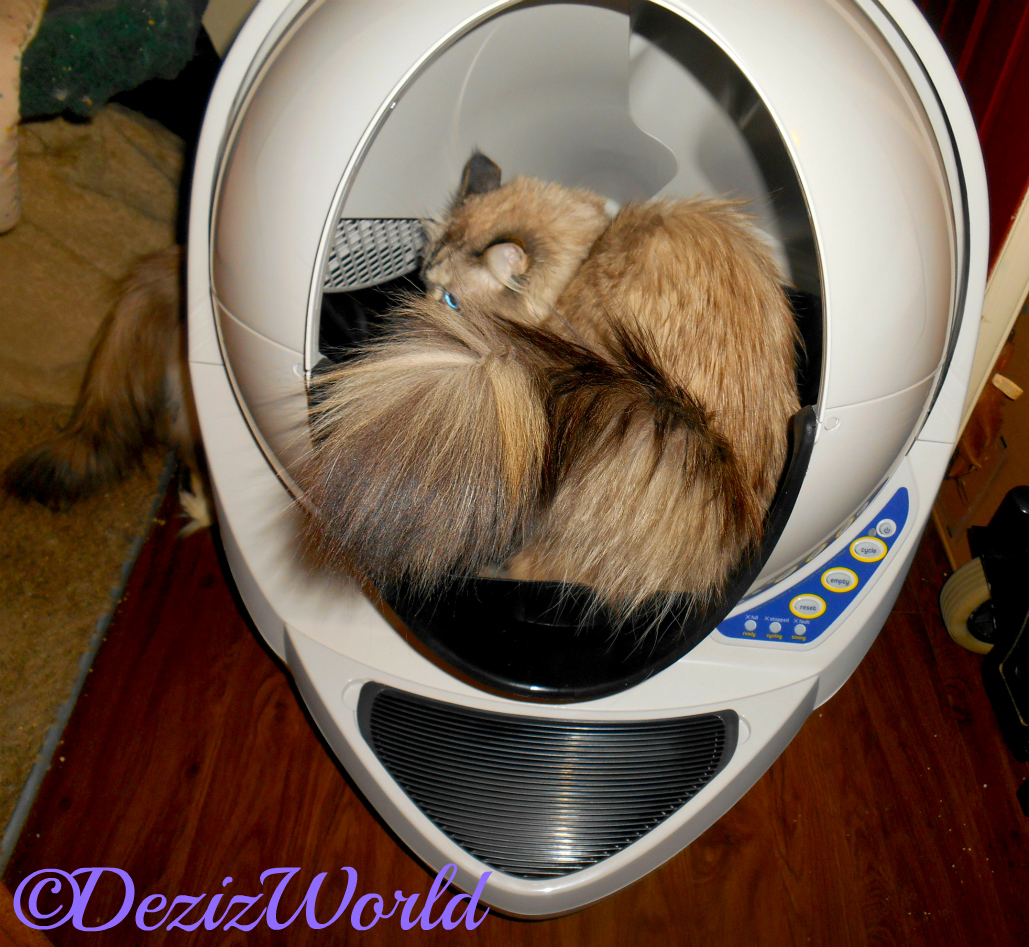
Is it mine’s turn now? Well it’s a bout time. I’s luvs, luvs, luvs PB the Litter Robot. I’s luvs to ride the rim sometimes. It’s so much fun. I’s still tryin’ to figger out how to make sissy go ‘round and ‘round like a ferris wheel. Fur some reason, it won’t cycle with her in it?. Other than that, I’s give it 4 paws up too.
(Dezi shakes head.) That’s a safety feature Raena. Fankfully, PB has better sense than you do. Cuz guess who’d be getting’ the whacky paw ifin you did send me ‘round and ‘round?. Anyways, we sure are glad PB’s working in our house. Ifin ya’ have any questions, thoughts or comments, purrlease leave ‘em in the comments section. And, any purchases thru the links in our posty mean we make a few green papers. Our Blessin’ today fur the Blessing Train is Health. We have been blest with good health. Yeah Raena’s eyes might be a bit purroblematic, but overall she’s healthy and we’re both happy.
















 Service Cats U.S.