Service Cats: How Long Does It Take To Train A Cat

MeOW and welcome to Service Cats and Everything Feline. What do ya’ think about our new name? Anyways, we’re getting some great questions, so keep ‘em comin’. ‘Member, there’s no dumb questions. Even the experts can still learn somethin’. Mommy says the day you think you can no longer learn anythin’ more is the day you become a fool. You can ketch up any time on any of the posts in this series by clickin’ the Training Tips and Everything Feline link in our menu board above. Please leave your questions or post suggestions in the comments below or send us an email via our Contact Page from the menu above. We’re glad ya’ll enjoyed last weeks post and hope we simplified the definitions somewhat and made it easier to understand the difference in the classifications of our Animal Helpers.


Dezi laying in cat tree in new harness


The followin’ post will be written in human English fur reader and translator ease. Our Service Cat posts aren’t intended to be an all inclusive Trainin’ Manual but rather Tips, Tricks and Techniques used/developed by mommy A thru her many years of animal trainin’, cats in purrticular. And to offur insight into your questions about Everything Feline. Always remember, Training is all ‘bout Repetition and Rewards.

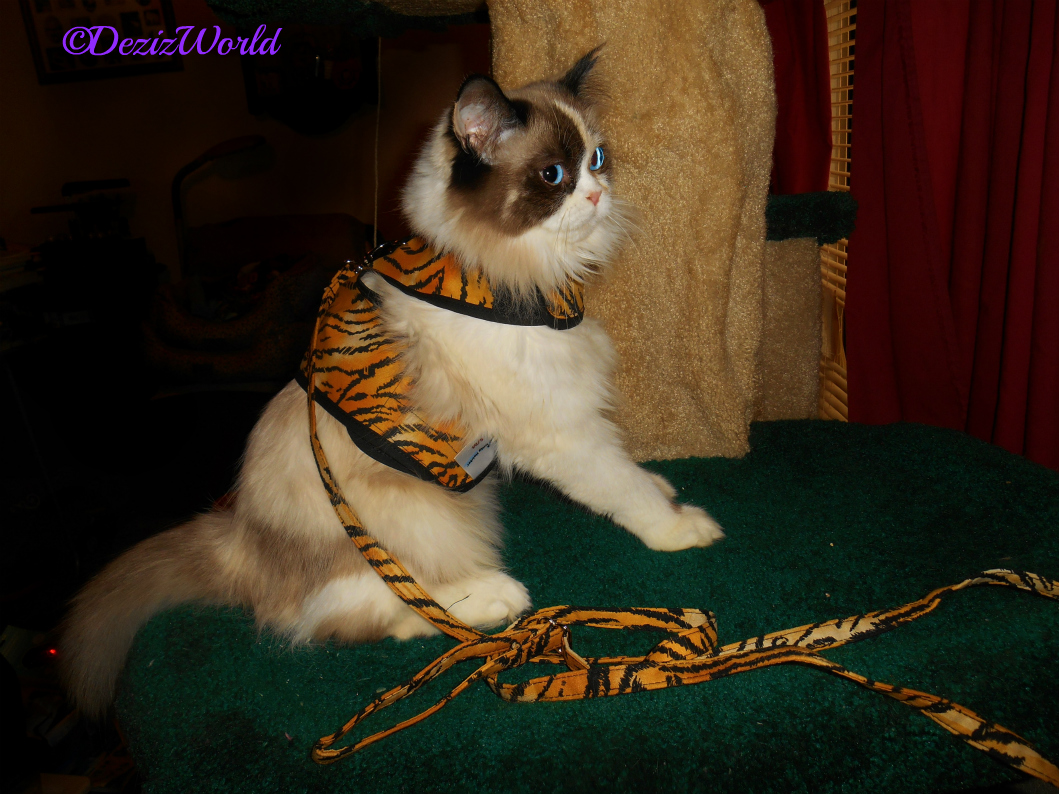
 Raena sits posing in her tiger harness


We were asked, “How long does it usually take to Train a kitty to perform a task?” Our general answer is going to be: Each kitty is different and there are a lot of factors that need to be considered when Training kitty; so the time it takes will vary. Any kitty can be Trained regardless of age, breed, “disabilities” or personality. Successful Training is always, always about Repetition and Rewards. Remember, when it comes to Training mommy says, “Learning doesn’t take a day off”. Mommy used to give piano lessons to humans of all ages. While most teachers give 30 minute a week lessons over the span of 10 years or more, mommy insisted on 1 hour a week lessons for 1 year without breaks or vacations. No summer’s off for mommy’s students. However, if they stuck it out, there’s nothing they wouldn’t be able to play, and in most cases could rewrite music into any key they wished in just minutes. Mommy is very serious about Training of any kind.

 

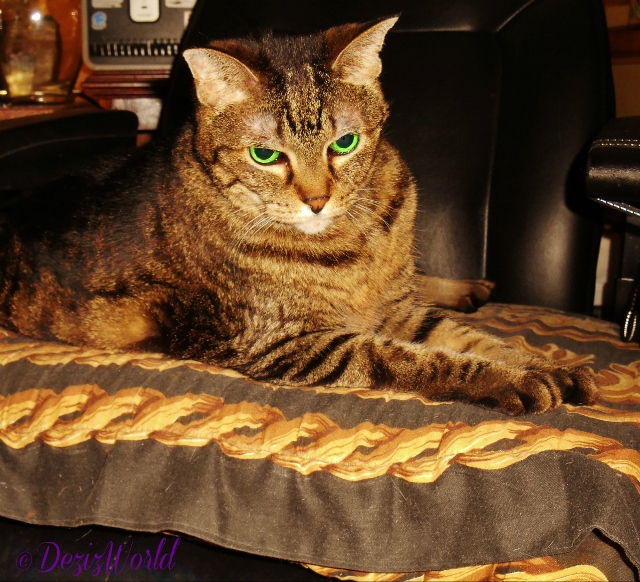
Shad lays on chair back

Shad (110 camera image)

That being said, let’s take a look back at some of the Service Cats mommy has Trained and how long it took to learn specific tasks. We’ll start with Shad, since she was mommy’s first Service Cat. If you missed Shad’s story, you can read it here. Shad actually Trained herself, but we can look at the sequence of events that occurred leading up to her first act of calling 911 for help. Mommy’s accident occurred in November. A lot of her problems were immediate including passing out. Shad’s first Service Cat act was to dial 911 on the telephone when mommy passed out and hit her head on an end table. She did this in March of the year following mommy’s accident. Mommy surmised that Shad had been observing her since November and realized that when mommy hit her head she was out longer and often more confused when she came too. The next task Shad taught herself was to move the shower curtain away from mommy’s face and push mommy’s head away from the water flow when she passed out in the shower. She first did this in April following the accident. Again, mommy surmised after receiving praise for her attempts to get mommy help, Shad stepped it up and wanted to do more to help. Shad was a small girl, weighing in at only 12 – 15 pounds on average, so she did the best she could considering mommy’s weight and size.
 

Lexi lays in wheelchair

Now let’s move to a Service kitty most of you are familiar with and one that mommy did Train, Lexi. Mommy determined that if Shad could learn those things on her own, then surely mommy could teach other cats to perform those tasks as well as others. When Training, one must always keep in mind the size and natural instincts and abilities of the animal being Trained. For example, you can’t ask or expect a kitty of 6 pounds to pull a manual wheelchair. You must have realistic expectations to be successful in your Training attempts. Since all kitties have the ability and desire to “knead”/”make biscuits”, Massage is one of the first tasks mommy Trains a kitty to perform. Even the smallest of kitties has some power in those paws. After all, that’s how they work more milk into the mother cat’s teats. Lexi’s mother had been killed while she was giving birth, so mommy had raised her from the beginning. Even tho’ Lexi didn’t have to “work” for her milk, she still had great kneading capabilities. The trick here is teaching kitty when and where to knead/massage and how not to use their claws. You can read mommy A’s Training Tips here. A kitten’s eyes and ears are open by the age of 3 weeks, and that’s when mommy started Training Lexi. Lexi was successfully giving mommy massages on demand by the age of 5 weeks. Only occasionally would she get over excited and bring out her claws. Please Do Not Declaw Your Kitty, they can be trained not to use them on you but on appropriate surfaces!!!
 

 6 month old Lexi laying on the couch

Lexi at 6 months (110 camera image)


Mommy started teaching Lexi about the phone when she was about 7 weeks old. She learned the number pattern to dial in about a month but wasn’t big enough or heavy enough to actually push the buttons down until she was about 4 months old. We know it’s hard to believe, but sis Lexi was that small at one time. She had 2 brothers at the time who she watched help mommy in the shower every day. At about 4 months old, she jumped into the tub on her own and tried to help them. She was too small to make a difference, but she learned what to do by watching them and eagerly took her place beside them when she finally got big enough. Lexi was about 3 years old when mommy got her first wheelchair. At that time, Lexi and 1 brother, Lucky remained with mommy. They took turns learning about the wheelchair.
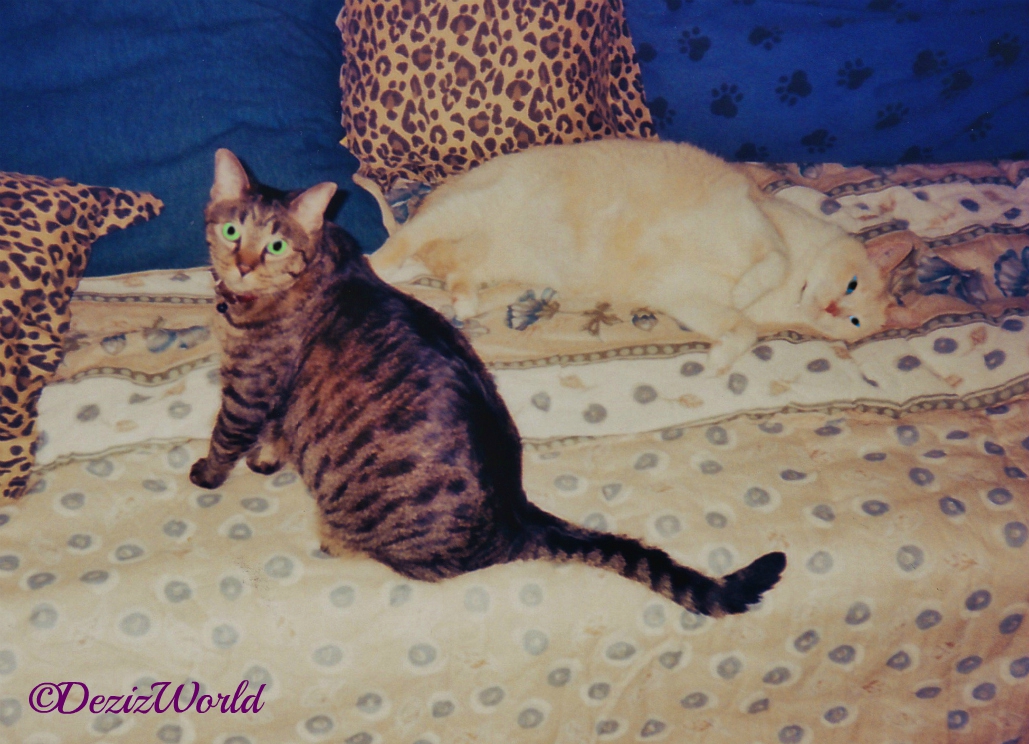
 

 Lexi and Lucky lay on bed

Lexi and Lucky laying on the bed. (110 camera image)


It took about 3 months before Lexi was comfortable enough around the chair to even ride in it. It was her brother Lucky that gave mommy the idea to train them to drive it. At the time, it was the only chair mommy had, so she sat in it most of the time. One night she and Lucky were relaxing in the chair watching television when he got up, pushed the power button, bit the joystick and propelled them forward. He seemed a bit shocked, but didn’t jump down. Lexi came running over and jumped up in mommy’s lap too. Mommy moved the chair back to where they had been and Lucky proceeded to repeat his actions. This happened over and over that night until mommy plugged the chair in and they went to bed. The next morning when mommy awoke, Lexi was sitting in the chair biting the joystick and trying to push it. A wheelchair will not operate when in charging mode.


 Lucky lays in wheelchair

Lucky laying in wheelchair (110 camera image)


We’re going to stop here for today. We’ll pick up where we left off next Friday, so be sure and stop by to see what’s next. And ‘member to leave your questions and post suggestions in the comments section below or send us an email via our Contact page. You can ketch up on any post you may have missed by clicking the links on our Training Tips and Everything Feline page from the menu above.


Till the next time……………………………………..Be Blest!!!


Luv and Hugs and Kitty Kisses 

 

Deztinee and RaenaBelle       

Service Cats: Defining Service, Therapy And Emotional Support Animals

Meow and welcome to another installment of Service Cat Monday on Friday. We’re actually going to be changin’ the name to avoid any confusion. We also want to remind you that you can ketch up on any posts you may have missed by clicking on the Training Tips and Everything Feline link in our menu. Please send us your questions and topic suggestions in the comments below or via our contact form on our contact us page.  


The followin’ post will be written in human English fur reader and translator ease. Our Service Cat posts aren’t intended to be an all inclusive Trainin’ Manual but rather Tips, Tricks and Techniques used/developed by mommy A thru her many years of animal trainin’, cats in purrticular. And to offur insight into your questions about Everything Feline. Always remember, Training is all ‘bout Repetition and Rewards.


Dezi laying in cat tree in new harness


     We got a great suggestion on our last post, asking us to feature other Service Cats and their duties. We so wish we could do that, but, there aren’t many actual Service Cats out there. We only know of one other, and his person/handler doesn’t like to discuss her disability or what her kitty does for her. We have to respect her right to privacy. Mommy said she agreed to be open and honest about everything when we started our crusade to bring awareness to Service Animals other than dogs, but not everyone else did. That being said, if you know of or have a Service Cat of your own, please contact us so we can share your story. You can use the contact form on our contact page or the Training Tips page. You can also send us an email directly to: lexi.dezi@yahoo.com.


 Raena poses on the Liberty cat tree in her tiger harness


     It’s a new year and we’ve gained some new followers, so we’d like to take today to remind everybody just what a Service Cat is. According to the ADA (Americans with Disabilities Act), a Service Animal is a dog that is individually Trained to do work or perform tasks for a person with a disability. There are no certifications or licensing’s required, nor is there any one place or government body overseeing the Training of such animals. Dogs and in some unique cases miniature horses are the only animals recognized as Service Animals that are afforded protections and rights under the law. The ADA definition doesn’t affect or limit the broader definition of Assistance Animal under the Fair Housing Act or the Air Carrier Access Act. That would be where our protections come into play.


Raena in stroller

     A Service Animal, regardless of species is well behaved, comfortable in just about every situation and IS NOT a pet. There used to be an old saying, “Children should be seen and not heard” when in public and especially around a lot of adults. The same is true of Service Animals/Cats. A Service Animal isn’t bouncing off the walls, or barking/meowing, being a nuisance, playing or drawing attention to themselves or their handler. The exception would be if the Service Animal’s task is to alert others to it’s handlers’ situation (ie: handler is having a seizure and requires human assistance, etc.). A Service Animal stays beside their handler at all times and doesn’t pull at their leash or try to interact with other animals or humans while in public. They are not easily distracted. That’s why it’s so important to ask the Animal’s handler before interacting with/petting the animal. The Service Animal is “on duty” and is not a pet. Altho’ we think the “ask before petting” should be a rule about every animal one might encounter other than their own. Just because an animal looks cute, doesn’t give you the right to approach him/her without getting permission from the owner first.


 Dezi sits in stroller


     There seems to be a lot of confusion about Service Animals, Therapy Animals and Emotional Support/Companion Animals. These three titles describe three completely different classes of animal and should not be confused with one another. We’ve given you the definition of a Service Animal and now we’ll define the Therapy animal and ESA (Emotional Support/Companion Animal.


 Therapy Animal:

This is probably the most recognized of the classifications and often gets confused with the Service Animal. A Therapy Animal is an animal (any species) that has been Trained to provide comfort and affection to people (other than their own humans) in hospitals, retirement facilities, schools and other such places. You might be asking what kind of Training is required to make an animal “provide comfort”. Truth is, this Training is more for the human handler than the animal. An animal chosen to be a Therapy Animal is one that is outgoing, comfortable with people and in a variety of situations, calm, and generally well behaved. Training teaches the handler how to prepare the animal (grooming, bathing, etc.) to go into these places and who/how to contact to set up visits in these places. Certification is required for Therapy Animals. If you think you have an animal that would make a good Therapy Animal, check with your shelter or the ASPCA about classes. But, a Therapy Animal Is NOT a Service Animal.


Raena lays sleeping in mommy A's lap

 Emotional Support/Companion Animal:

The Emotional Support animal is any PET that provides health benefits to a person. That’s pretty much all animals. There’s no Training required nor any certifications. This group is growing as more and more people move into homes/apartments requiring rental assistance. Usually pet deposits./fees are waived for those who can get their doctor to write a letter stating they require their animal for emotional support. These animals ARE Pets and NOT Service Animals. This classification comes with no rights, protections or privileges under the law other than that of personal property.


 Dezi lays in lap and gets loving


The bottom line here is that all animals are special and give health benefits to their owners. But, not all animals can be called Service Animals. Mommy says we’re the most special kitty girls on the planet, but not any more special than the kitty or doggy that lives with you and gives you joy, comfort and love. We just help mommy in a different way. We still provide her with joy, comfort and lots of love, but we’ve been individually and specifically Trained to perform certain tasks that help her to live independently. We’ll be talking more about those things soon. We’ve been asked some questions that we thought we had already answered, but again, we’ve had quite a few new followers. Mommy says it never hurts to tell something again just in case it was missed the furst time. So join us here each Friday for a look into our lives as Service Cats and answers to your questions about everything Feline. Purrlease leave your questions in the comments or send us a message via email on our Contact us page. And don’t furget, you can check out all the posts in this series by visiting our Training Tips page. And let us know ifin you know a Service Cat. We’d luv to meet them and share their story with everypawdy. 


Till the next time………………………………………….Be Blest!!!


Luv and Hugs and Kitty Kisses
 

Deztinee and RaenaBelle

Service Cats: Q & A About The New PowerChair

MeOW and welcome to our first Service Cat post of 2018. We’ve been chompin’ at the purr-verbial bit to get started. Me wants to point out a few changes we’ve made in an attempt to make these posts easier to find, and easier for you to ask questions. First, take a look at our menu options. We created a whole page with the links to every post in this series called Training Tips and Everything Feline. We will be adding descriptive tags so that you can easily find exactly what you’re looking for. We had hoped to have that done already, but as most of you know, we’ve had a few challenges keeping us busy elsewhere. Rest assured we will be doing that in short order. You will also find a contact form on the page that is completely private. Just fill it out with your questions or post suggestions and we’ll receive an e-mail readable only by us. If you’ve missed any posts in our Service Cats series, you may check this page to get all caught up. As Always you may continue to ask questions in the comments of our posts; we luv, luv, luv hearing from you. Remember when asking behavioral questions to purrlease be as specific as pawssible. Let’s get the business outta the way and get this pawrty started.


Dezi laying in cat tree in new harness


The followin’ post will be written in human English fur reader and translator ease. Our Service Cat posts aren’t intended to be an all inclusive Trainin’ Manual but rather Tips, Tricks and Techniques used/developed by mommy A thru her many years of animal trainin’, cats in purrticular. And to offur insight into your questions about Everything Feline. Always remember, Training is all ‘bout Repetition and Rewards.

We had a lot of questions last year regarding the new PowerChair/WheelChair. Just in case you’re new to our blog, let me explain. Mommy’s PowerChair broke last June. One of the motors went out and the chair wouldn’t do anything but turn in a circle. Being over five years old, Medicare wouldn’t pay to repair it; so, we had to go thru the procedures to get a new one. Unfortunately, that process is long and tedious. We finally got approved and received our new PowerChair in January of this year. Here are some of the questions ya’ll asked about the new PowerChair and our Training/Ability to use it:


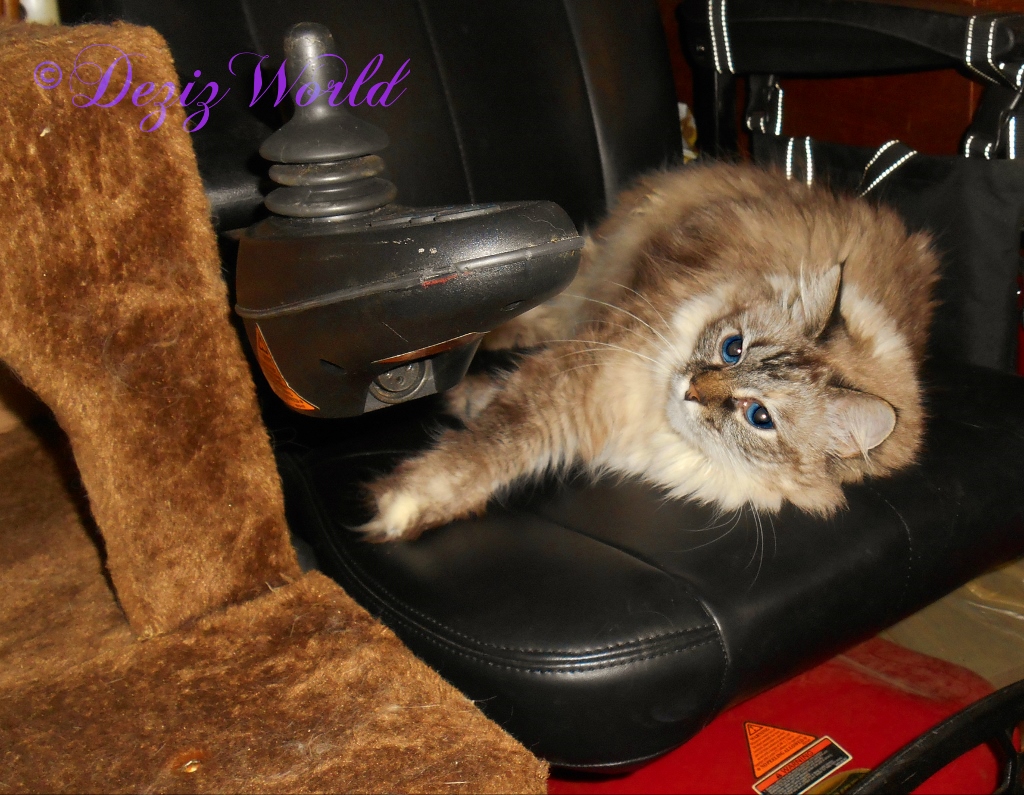
 Dezi lays in the wheelchair

Old chair, but the joystick is the same on most chairs. It’s made of a

flexible rubber type material. 


Q: Isn’t the joystick hard on a cat’s teeth?

     A: The joystick is covered in/made of a fairly soft rubberized material, so it’s not any harder on a cat’s teeth than many of our toys.


Q: Does a repairman come out and evaluate the chair, and what steps are required to get a new PowerChair?

     A: Yes, a repairman comes to our home to determine what’s wrong with the chair and if it can be fixed. If a PowerChair is over 5 years old, Medicare will not pay for repairs. So, the repairman must take measurements for a new PowerChair. The measurements required are the length of a persons arms, legs and torso. Measurements are also taken of the person’s width between the arms and weight. Other questions that will be asked is if the person has problems with incontinence, diabetes, ulcers or sores on their hiney, and the width of all doors and hallways in the home. Once those measurements are taken, the repairman will submit a request for a prescription from the person’s doctor. The person, (ie: mommy), must then see the doctor for a mobility evaluation, as well as a physical therapist. They will submit their evaluations along with a prescription to the PowerChair repairman who will submit it to Medicare for approval. The approval process can take as long as a year. There are emergency situations that can speed up the process, but it’s always best to expect a bit of a wait. 

Dezi checks out the new Powerchair


Q: Does the new PowerChair come with instructions or do we just have to figure it out ourselves?

     A: The new PowerChair comes with a packet that explains how to assemble the chair and connect the control panel to the batteries as well as a description of the control panel. A small booklet with care instructions is also included. There’s no instructions on how to drive, which is why mommy ran into everything the first time she powered up. 


Q: Why does it take so long to get a new PowerChair and do we have a manual chair we can use in the meantime?

     A: We don’t know why it takes so long, but if you ever figure it out, let us know. MOL As for a manual chair, the answer is NO. Medicare and most insurance companies “rent” equipment in a succession based on health. That simply means they start with things such as canes and walkers and move up. Mommy skipped the manual wheelchair step because certain movements required to power a manual chair would cause her to pass out. She went straight from a cane to a PowerChair. So, when it’s broken, she’s left to get around however she can. In her case, that means crawling for several hours a day.


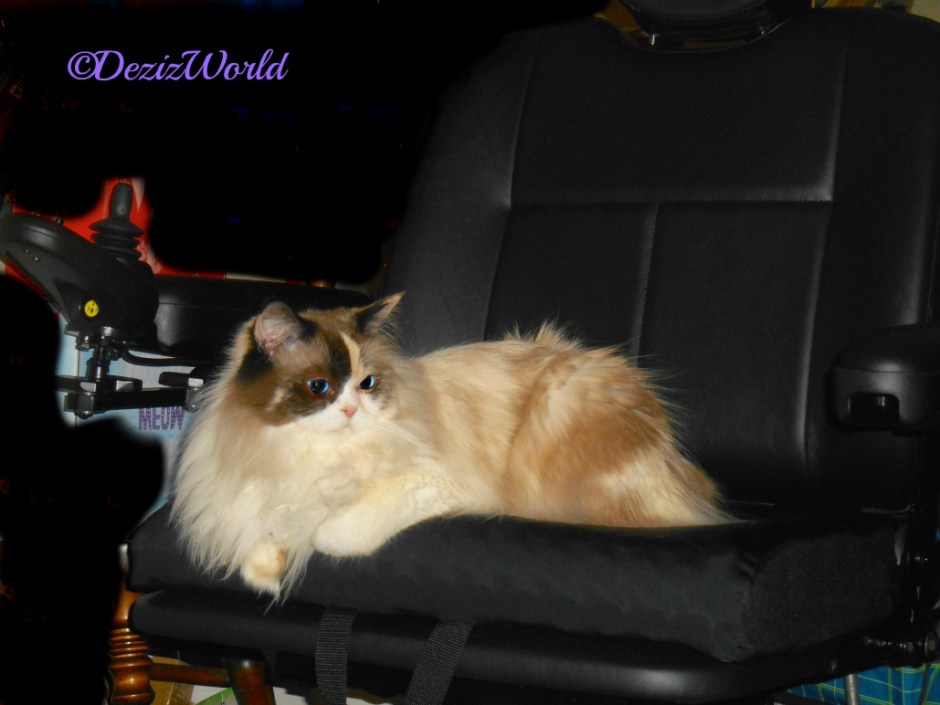
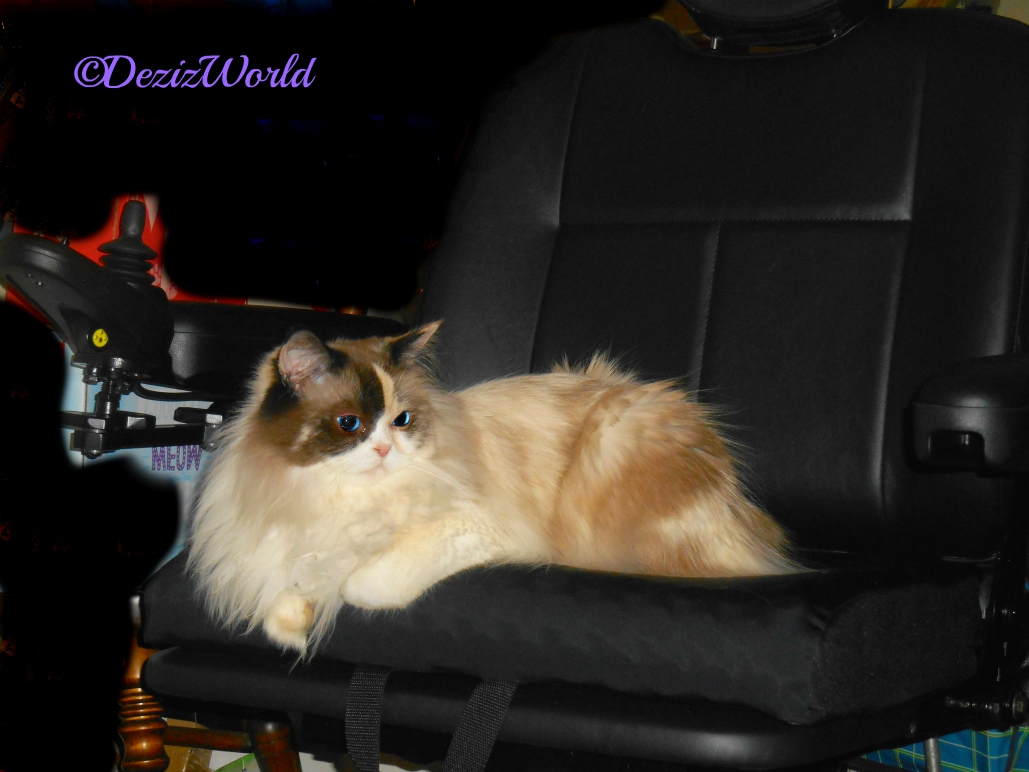
 Raena lays in new powrchair


Q: Once the new PowerChair arrives, are we able to drive it or does it require re-Training

     A: Quite a few of you asked this question; but, until the new PowerChair got here, we couldn’t know for sure how to answer it. This is mommy’s third PowerChair, and each have been a little different. The first and second chair rode and drove pretty much the same and required no additional Training. Our new PowerChair however, rides and drives much differently than the previous chairs. The differences are subtle, but they are there. Enough so, that we will both require some new Training. Actually, me should say all three of us need some additional Training. The first time mommy powered on, she ran into everything and even fell off the sidewalk outside.


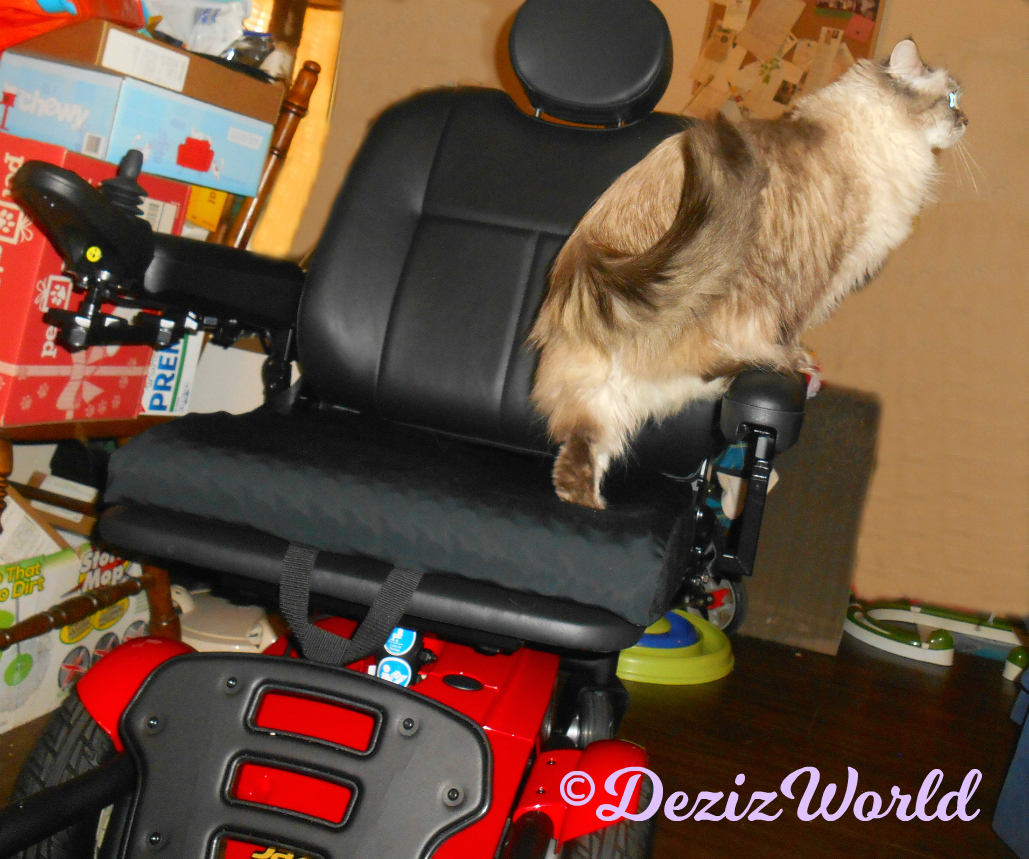
 Dezi climbs on the new powerchair

The view seems better from the new chair. And, the arms seem wider.


     What are those differences, you ask? Well, for starters, the old chairs had a 360° turn without moving forward or backwards. The new PowerChair moves slightly forward when turning to the right, and slightly backwards when turning to the left. That may not sound like much to you, but due to limited space in our apartment, it can mean the difference in successfully turning around or hitting doors and walls and any other furniture that might be near, as well as falling off the curb. We have a very small kitchen and bathroom, so turning around becomes difficult in this chair. We’ll be doing more “backouts” instead of actual turning around. Mommy also says this joystick is very touchy. One little push or pull and the PowerChair starts moving. Altho’ that’s a good thing, it’s not something we’re used to and will require a few hours of additional Training. After all, we are cats and do find ourselves occasionally re-scenting the joystick with a little face rub. We for sure don’t want to go wheeling through the wall just because we showed the joystick some love. MOL  The speed control on the new PowerChair is a dial up instead of a push button. Mommy hasn’t decided yet if that’s a good thing or not, but we’ll keep you posted as we go along. One small detail that others wouldn’t have given a second thought, is that the power button and horn are in the opposite positions from any chair we’ve ever owned. And the back wheels not only touch the floor all the time, they’re also the same size as the front. 


 Raena lays in the new Powerchair


     So, a lot of little changes mean a lot of extra Training. Remember, altho’ the old chair was broken, we still had some form of Training each day, we just didn’t move. Getting used to moving again, is going to take a little time. However, mommy’s confident we’ll be ready for the races in no time. 🙂  


Well, we hope we’ve answered the questions you all had about the new PowerChair. We’ll be posting more about our Training as well as tackling any other questions ya’ll might have. ‘Member, there are no stupid questions. Ifin you’ve been wanderin’ somethin’, you can rest assured you’re not alone. And be sure to check out our menu page Training Tips and Everything Feline to get caught up on any post you may have missed in this series.


We have a favor to ask. As you all know, we really want to go to BlogPaws this year. It’s a state over in Missouri. That’s just too close to miss, we think. Anyways, it’s time to submit your favorite blogs fur the Nose to Nose Awards. We fur sure would luv to be recognized and receive one of those pawsum awards. We’d really appreciate your nomination of our blog fur one or more categories. We’ve tried to make this as easy for you as pawssible, so, you can just do a copy and paste of the links. Here’s the categories we qualify for and the information you’ll need to submit us. Purrlease take a couple of minutes and fill out the form here. Fank you all so very much. 

Best Cat Blog:

https://dezizworld.com/2017/07/31/service-cats-fighting-or-posturing-introducing-cats/ 

Contact/Creator Name: Audra High

Our email address: lexi.dezi@yahoo.com that’s lexi (dot) dezi (at) yahoo (dot) com. No spaces of course.

Our BlogPaws Profile:

http://community.blogpaws.com/members/lexi-dezi/profile/ 

Our Facebook Page:

https://www.facebook.com/Alexandra.Furiends

Our Twitter Page:

https://twitter.com/DezizWorld 

Best Written Pet Blog Post: Use the links above, unless you think another post was our best. If you choose another post, purrlease let us know which post you nominated. You may nominate more than one post or blog, it just has to be on a new form. Posts that are qualified for nomination/consideration: Any post created/published between January 2017 through February 2018.


Best Photo on a Pet Blog: We had a lot of trouble trying to narrow this one down. Purrlease feel free to choose one of the following, or you may choose any other foto of us on our blog:

https://servicecatsus.com/wp-content/uploads/2016/12/dw-dezi-n-raena-brown-treedscn8326edit-1024×807.jpg

https://servicecatsus.com/wp-content/uploads/2017/12/dw-raena-bathes-tongue-out-0362.jpg

https://servicecatsus.com/wp-content/uploads/2017/06/dw-dezi-looks-up-n-hisses-at-raena-on-liberty-cat-tree-9355.jpg

Best Written Blog Post, Sponsored

https://dezizworld.com/2017/03/22/lllt-a-safe-non-invasive-way-to-treat-many-pet-maladies/ 

We really ‘purreciate ya’ll takin’ the time to nominate us. If you’ve chosen a post or foto different from the links we provided, just let us know. We’re always innerested in knowin’ what you luv ‘bout us or our blog.


Till the next time…………………………………..Be Blest!!!


Luv and Hugs and Kitty Kisses


Deztinee and RaenaBelle

Service Cats: Feline Nutrition: The Obligate Carnivore

MeOW Welcome to Service Cat Monday. What started out as a simple Training day post quickly evolved to encompass all things Feline. It’s the one day a week, we focus on educating and writing fur the humans in our lives. We wanna thank all of you fur your questions, comments and readership this past year. Keep the questions comin’. ‘Member, the only dumb question is the one not asked. This will be the last Service Cat Monday post of the year 2017. But, don’t worry, this series will return fur 2018. We haven’t even begun to scratch the surface of the complexities of the Feline Behavior (pun intended). That bein’ said, let’s get the business outta the way and get on with today’s post. The followin’ post will be written in human English fur reader and translator ease. Our Service Cat Monday posts aren’t intended to be an all inclusive Trainin’ Manual but rather Tips, Tricks and Techniques used/developed by mommy A thru her many years of animal trainin’, cats in purrticular. And to offur insight into your questions about Feline Behavior. Ifin you have any questions or topics you would like us to cover, purrlease let us know in the comments section or send us an email. When asking behavioral questions, purrlease be as specific as pawssible. And, ifin you’ve missed any of the posts in this series, you can ketch up by clickin’ the links at the end of this post. Always remember, Training is all ‘bout Repetition and Rewards.


 Dezi laying in cat tree in new harness


We get asked a lot about food and proper nutrition for us kitties. As most of you know, we eat a raw freeze dried food and are adamantly opposed to feeding any kitty a kibble only diet. And as most of you also know, we have semi scheduled feedings and don’t believe in leaving food out all the time for kitty. What we mean by Semi-Scheduled, is that we eat at specific times a day. Altho’ breakfast is served when mommy can get up and make our plates, dinner is almost always served within a hour of the same time each day. Those plates are available for a limited time and then empty or not, they disappear until the next meal time when they are replaced with a fresh plate of food. One comparison you can make between kitties and humans is, if you can sleep without getting up to eat, so can we.


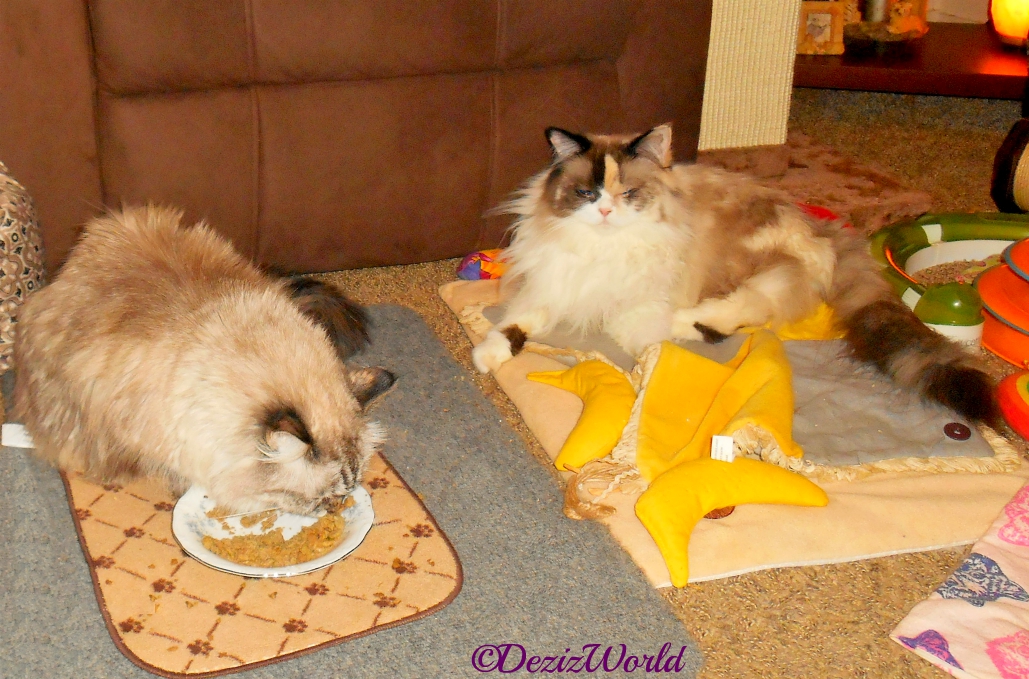
Dezi watching Raena while they eat

To understand kitty’s nutritional needs, we must look at the feline roots, the wildcat from whence we came. We believe in creation, and that God created the first cats. However, you want to see it, Cats exist and are among the few True Carnivores. We call them Obligate Carnivores, meaning they MUST eat meat to survive. The dictionary says this about Obligate: Biologically essential for survival. Cats Can Not live much less Thrive on a vegan or vegetarian diet. A cat’s teeth are designed to rip flesh and chew meat, muscle and tendons. The cat’s tongue is barbed to help it remove fur and feathers from their prey. Cats lack the physiology required to break down or digest vegetation, starches and/or some carbohydrates.


Veggie clip art


Cats’ require certain Amino Acids such as Taurine, Tryptophan and Arginine that is found in animal flesh. While the human body is capable of breaking down carbs and producing certain Amino Acids on it’s own, the cat must get those from their food. A cat who doesn’t get the required nutrients in their diet, may go blind, suffer muscle loss, other illnesses and even die. A cat in the wild, will also get moisture from their prey. Cats consume blood, predigested vegetation and other wet contents from their kill. This practice has led to a smaller liquid intake by cats and more concentrated urine. We’re all familiar with the overwhelming smell of cat urine. However, fresh water should still be available for kitty at all times.


 Meat Meal for pet food

(Meat Meal) Looks more like chicken feed than somethin’ us

kitties can sink our teethies into.


So, let’s take a look at Kibble. It’s a well known fact that the first three ingredients listed make up the largest part of a food/feed. Now we know every bag of kibble lists a moisture content. But, we also know anyone who has ever touched a piece knows there’s nothing moist about kibble. If you were to put a piece of kibble in a spoon full of water, the kibble would soak up all the liquid in no time. So, imagine what it’s doing inside kitty who never drinks their 8 glasses of water a day (mol). No, kitties don’t need 8 glasses of water a day, that part was a joke. But seriously, cats don’t always drink enough water, so when kitty eats something that will absorb any liquid around it, it’s a disaster waiting to happen.


 Veggie clip art

Some grain free options. Does a kitty look like a rabbit?


There are 2 basic diets available, regular and grain free. Grain free diets commonly include starches such as potatoes. As we pointed out earlier, cat’s generally Do Not have the ability to break these down. An inability to digest these starches in cats may cause kitty to become gassy, have diarrhea or bloat. Kibble may also cause kitty to gain weight and be at risk of becoming obese. Kibble only diets also increase kitty’s risk of Urinary problems. For many years now, it’s been known that a lot of the pet food manufacturers use less than desirable ingredients in their kibble and even canned feeds. The laws protecting animals and ensuring the quality of food are too often not enforced. Animals that have been euthanized or died from illnesses/disease are often used in the manufacturing of pet feed. Even companies that charge outrageously for their products are guilty of these practices.


 Dezi eats Raena's left overs

Me hopes mommy doesn’t ketch me cleanin’ Raena’s plate.


Even more alarming than the above is what happens to a kitty when kibble is left available at all times. Contrary to the belief that kitty will go hungry overnight, or while you’re away at work, we kitty’s were never intended to eat 24/7. And believe it or not, we can even last a few extra hours when you’re running late. Most kitties can safely go without a meal every now and then without any harm or danger to their health (Only healthy cats, not those affected by an illness or disease. Please speak with a VET before fasting any cat who is sick). Let’s talk about kitty’s sniffer and food for a minute. When kitty smells food, a chemical reaction happens that causes kitty’s body to produce needed acids to break down the food for use. When food is left out all the time, kitty’s brain is on overload. The body can quit producing those acids or over produce them which can lead to illness, obesity and even death. A hunting cat isn’t always successful and may not eat every day. We’re not suggesting you fast kitty, but we are saying, kitty doesn’t need to eat all day and night.


 Dezi and Raena eat

Dry Freeze dried Primal (not recommended by manufacturer).

Now we luv the gravy. 


A few years ago, me was a grain free kibble eating kitty. Until that is, me got sick and mommy learned me’s urine pH was off the Alkaline charts. Me was on a Semi-Scheduled feeding, but me’s body just couldn’t break down all those potatoes. Me was stubborn and didn’t want to give up me’s kibble. Thankfully, mommy’s more stubborn than me and knew what was best. While we don’t recommend it, mommy began to feed me the Freeze Dried Raw food…DRY. Freeze Dried raw should be reconstituted with water or broth. However, me just wouldn’t eat it, so mommy left it as is. About a week later, mommy began serving me’s freeze dried raw on a damp/wet plate. A week later she used her fingers to sprinkle water across the top. The next week, she added a spoonful of water and so on. Now me can’t imagine eating a food without that delicious gravy. The more the better me meows.


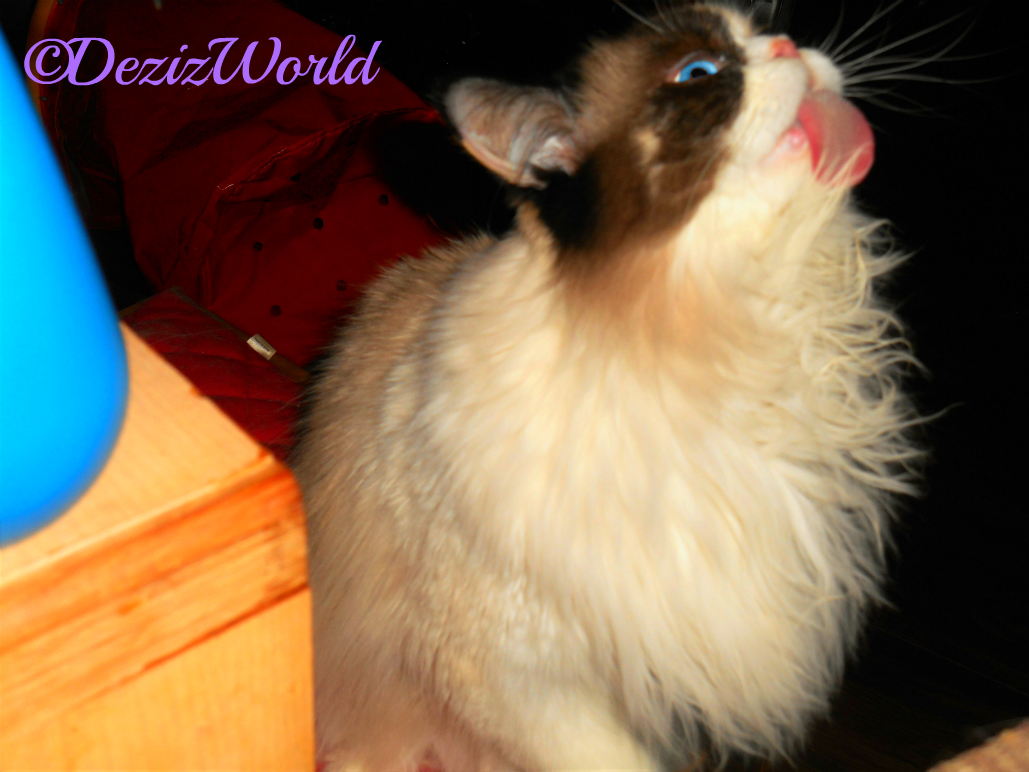
 Raena watches Dezi sniff the Thirsty Cat fountain


We also added water fountains to make drinking more appealing and fun. After much research and many calls to pet food manufacturers about their ingredients and manufacturing policies, we eat and recommend the Primal line of foods. They truly use human grade ingredients. Yes, it costs a bit more than kibble or canned, but it’s the next best thing to mommy making our food herself. And, for those who don’t want to touch raw ingredients or need easy raw food due to travel, it’s convenient. Me’s urine pH is healthy and normal now, and Raena and me are generally healthy and happy.


 Dezi eats while Raena watches from the side.

Me’s lappin’ up the last of the gravy so mommy can add more.


If you’re not ready to make the Raw leap, canned food is the next best choice. It is a myth that kibble cleans kitty’s teeth. It is also a myth that a Persian cat and a Siamese cat have different nutritional needs or require breed specific formulas. That’s one of the craziest money grabbing schemes we’ve ever heard. All Cats are Obligate Carnivores and therefore require the same nutrition…MEAT. Not meat by products or meat meal made up of some unknown animal parts or plant proteins. Mommy says when deciding what meats to feed us, she likes to think about our wild ancestors. She asks the question, What kind of meat would kitty hunt for if left to their own devices? Very few cats actually fish. Most of a cat’s food sources come from land mammals who eat both meat and vegetation and supply kitty with all the nutrition he/she requires. 


 The Blessing Train


Well we do hope this has helped some of ya’. Obviously, this is a huge topic and there’s much more we could have added. So, ifin ya’ want us to expound more, let us know. Fur now, we’re gonna wrap this up and do some more Christmas purrep. Don’t furget to leave your questions, comments and/or topics below or send us an email. And, you can ketch up on any posty you may have missed by clickin’ the links below. One last thing, our Blessing today is Good Food and Nutrition. Fanks mommy, fur lookin’ out fur us.


Till the next time…………………………………………Be Blest!!!


Luv and Hugs and Kitty Kisses


Deztinee and RaenaBelle


Service Cats  

What to Look For      Training Foundations      Train Kitty To Massage

Smelling Disease      Do You Need One      Who Bears the Cost

Housing Laws & Exceptions      Accommodations & Common Sense

When the Handler Dies      Proper Training Methods Pt. 1 & Pt. 2

Easiest Task to Train      Getting Kitty Ready for an Outing

Discipline: Stop Countersurfing Kitty      Internal Disputes

Calling Emergency Help      Just What Is Kitty Capable of

Shad: Original Service Cat      Harness, Vest, Leash or Stroller

Dezi, the Wheelchair & Chest      Round and Round We Go

Tumble & Fall Response      Raena Calls for Help

The Rest of the Story     Raena & the Wheelchair Pt. 1 Pt. 2 Pt. 3 Pt. 4

When to Train      Explaining Rewards & Kitty’s Feelings

Stop Kitty’s Begging     Calling For Help Options Pt. 1

Medicating Kitty

Training the Pig Headed, Stallion Strong, Submissive Pup & Conniving Cat

Cats Love Training & Social Media Downfalls

Reintegrating the Scared or Bullied Cat      There’s No Bully Cat Breed

Going for a Walk When in a Wheelchair     Calming the Tiger Pt.1 Pt. 2 Pt. 3

Surviving A Remodel      Taming A Feral Cat

Designer Cats & Scent      DNA Doesn’t Change      Fighting or Posturing

Clicker Training & Operant Conditioning      Wheelchair Training

Basic Training Continues      Managing Without A Wheelchair

Are Spray Bottles Effective      Hands Are Not Toys

Does My Cat Need A Friend      Helping Your Bullied Shy Cat

Why Cats Scratch      Halloween Safety      Stop Cord Chewing

Pica: Unusual Habits      Holiday Safety Tips     Feline Urinary Habits