Welcome to another Service Cat Monday. We wanna take a minute to clear up a few things. We received a few comments on our last post that seem to be a little confused. Mommy in no way endorses feral cats as Service Animals. Service Cat Monday started out with us telling about our specific training. However, we quickly learned that lots of peeps had kitty issues they were living with that could be corrected with a little training. So, we opened Service Cat Monday up fur any and all questions. Because of mommy’s experience with animal training, we wanted to help, and will continue too. We believe all kitties can benefit from some basic training, but, that doesn’t make them Service Cats. We hope that clears things up a bit.
Now, let’s get to today’s posty. And ‘member, ifin you’ve missed any of the posts in this series, you can ketch up by clickin’ the links at the bottom of this post. The followin’ will be written in human English fur translator and reader ease. We’re runnin’ low on questions, so ifin you have any questions you’d like an answer to, purrlease leave ‘em in the comments or send us an email. Our Trainin’ posts aren’t meant to be a step by step Trainin’ manual, but rather Tips, Tricks and Techniques mommy has used/developed throughout her many years of animal trainin’, cats in purrticular. And ‘member, ifin you have a behavioral question, purrlease be as specific as pawssible.
Photo Courtesy of Wikipedia.org
We have a couple of questions today that won’t take a whole post each, so we thought we’d address them together. First up, our sweet Weimareiner friend Phenny asked, “What do you think about all these Designer Breeds/Cats, like the Savannahs, Chausie, etc.?” Well, Da Phenny, we can sum it up by saying, We Hate Human Manipulation in the natural process of Any animal breeding!!! “Designer Breeds” as they’re called, often come with a host of health problems, and aren’t actually suited to life as a pet. You mentioned the Savannah specifically, so we’d like to address that particular breed. The Serval, which is the wild cat that makes up one half of this breed doesn’t actually desire to breed with the Domestic Cat. And the gestation period for the Serval and Domestic Cat differ which means that pairings can result in natural abortions, premature births and even absorption of the pregnancy. The resulting kittens are indeed attractive, but not actually suited to every household. They are extremely smart, large and highly energetic. They are completely driven by their wilder/baser instincts. For a complete look at these instincts, please see our post, There’s No Bully Cat Breed. Just because humans can do something, doesn’t mean they should. Science has proven that Natural bred cats are healthier, live longer, and are more suited to living with humans. We hope that answers your question. You can also see Wikipedia, TICA and the CFA websites for more information on these and all cat breeds.
Our next question comes from our dear Persian friend Valentine. Val asks, “I live with a D-O-G that I’m always sniffing. Am I marking my doggy or checking to make sure it’s still the same D-O-G?” Well Valentine, as we discussed in a previous post, us kitties use smell over eyesight to determine what’s in our world. Almost all of our communication with other animals can be summed up with scents. When you live inside, where most all kitties should live, the scents don’t change that often. Sure, the occasional visitor, or your human’s return from work, shopping or errands, can bring new scents to explore, but most of the time, there’s little to no animal communications. However, when the D-O-G goes outside to take care of their business or exercise, they return with lots of great information from the big outdoors.
The dog may have stepped in or brushed up against a spot where another kitty walked, rubbed, or otherwise marked. Yes, this can even happen if the doggy only goes out in your yard. Stray and feral cats know no boundaries. MOL When the dog returns inside, us kitties must sniff and take in all the information from the great outdoors. This will usually be followed by some form of marking the dog. You know, we’ve got to reclaim our family members as often as possible. A cat in the wild will mark their territory several times a week in order to keep the scent fresh and let others know the territory is taken, by whom, and breeding status. Those of us inside, do the same thing with our humans, other animals, furniture, etc.. The same post as above, There’s No Bully Cat Breed, explains what drives a cat to do the things we do. So, to answer your question Valentine, you are smelling the D-O-G to make sure it’s still your doggy, but also to get information about your extended world; the great outdoors. This behavior would remain the same, even if you were allowed outside. Remember, us kitties use scent above all other senses to make determinations about our world.
Well, that’s gonna do it fur today. No actual Training tips today, but we said we’d take any and all questions. And, we think these were some great questions, so fank ya’ll fur askin’. Ifin you have any questions, purrlease let us know. We actually enjoy these postys and hope you do too. ‘Member, ifin you’ve missed any of the posts in this series you can ketch up by clickin’ the links below.
Welcome to a brand new Service Cat Monday. We do hope you all are enjoyin’ these posts and that they are helpin’ ya’ with your own kitties, doggies, etc.. ‘Member, we’re takin’ any and all questions ya’ have, whether they be ‘bout Trainin’, Health, or anythin’ else kitty. We’ll also try to help with other animals ifin ya’ have a specific question. Purrlease be as specific as pawssible when askin’ ‘bout behavioral issues. You can leave your questions, comments and post suggestions in the comments below, or send us an email via our totally purrivate Contact us page. As with all our Service Cat posts, the followin’ will be written in human English fur reader and translator ease. These posts aren’t meant to be a step by step Trainin’ manual, but rather Tips, Tricks and Techniques used/developed by mommy thru her many years of training animals, cats in purrticular. Ifin you’ve missed any of the posts in this series, you can ketch up by clickin’ the links at the bottom of this or any Service Cat Monday posty. Now, let’s get to today’s topic.
Our sweet Weimaraner furiend Phenny asked a couple questions a little while back, and we wanna address one of those questions today. Phenny said, “My aunt adopted a feral kitty. Is there any hope of taming him?” First up Phenny, thank your aunty for us. We’re really happy that she took in a totally unadoptable kitty. We say totally unadoptable, because the shelters say that. But the truth is, even a feral kitty can be trained and tamed. Anyone who has ever cared for a feral colony knows this, whether they realize it or not. What do you think is happening when you show up with food and they come running? The feral colony has been trained to show up at a specific time and place, and they will be rewarded with food and usually some sweet talk. Over time, they’re rewarded with love and vet care too. We’ve had ferals show up at our apartment many times through the years. They quickly learn when mommy is able to get around and give them something to eat and some fresh water. We know this to be true, because if mommy happens to get around earlier, there’s been no feral in sight. But, just like magic, around the same time each day, the feral kitty(s) suddenly appear.
Anyways, let’s talk about Training a Formerly Feral kitty to live inside. Last week we talked about a “Decompression Room”. A Decompression room can be used in many situations. Remember, us kitties don’t like change, and a feral is generally terrified of humans. You must understand, a feral is not acting out of meanness or spite, but rather, FEAR. Whether the feral is the result of abandonment by a past human or born from generations of ferals, their biggest motivator is survival. Part of that survival has conditioned (Trained) them to fear humans. So, when you adopt a feral kitty, you can expect to see many inappropriate behaviors as the kitty learns to adjust and Survive in their new territory. Once you’ve decided to take in a feral, make sure they can’t get outside again. Training is all about Repetition and Rewards and it’s hard to be repetitious with a kitty you can’t find.
I’s hidin’ out. You can’t really see me. MOL
Making Kitty Comfortable
Kitty should be placed in a “Decompression Room” after seeing a VET to rule out any possible illnesses or diseases, and a spay/neuter. Remember the ‘Decompression Room” should contain a litter box, food, fresh water, scratcher, a couple of covered boxes/carriers (good for hiding), a few toys and/or cat furniture of some kind. If there’s a window in your “Decompression Room”, kitty should be able to look out. A couple of scent soakers should also be placed within the “Decompression Room”. We were asked last week what piece of clothing made the best scent soaker. Mommy says for women, the best scent soaker is a bra; and for men, it’s an undershirt or cotton t-shirt. Remember the scent soakers should contain the scents of all residents of the house. Don’t rush kitty to be affectionate or you may lose any progress you’ve made. And, be sure to place the litter box away from the food and water bowls. Altho’ a hungry kitty will eat close to the litterbox, ideally, kitties don’t want to eat beside their toilet, do you?
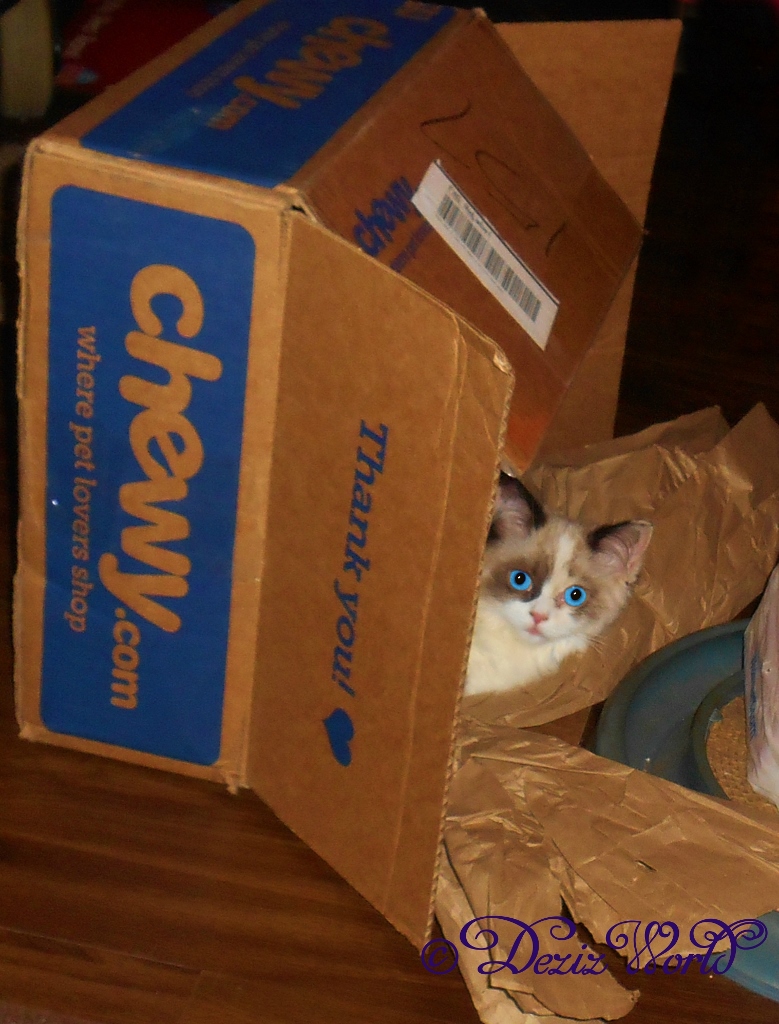
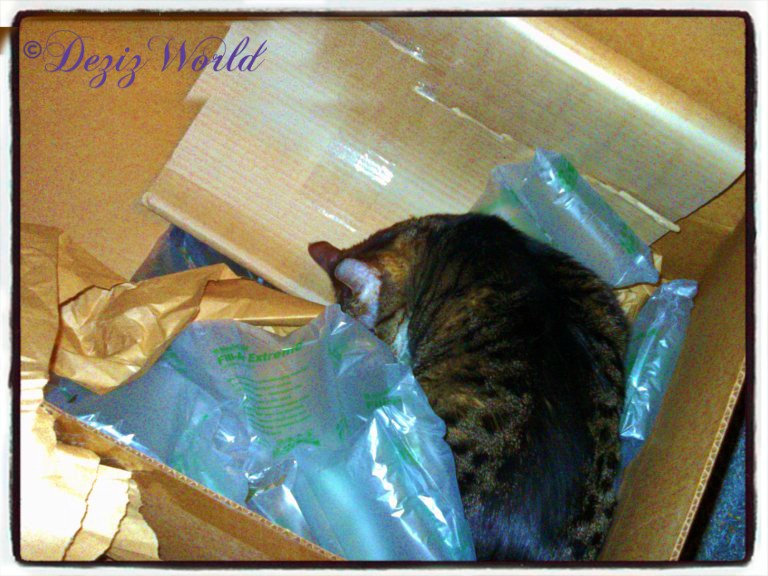
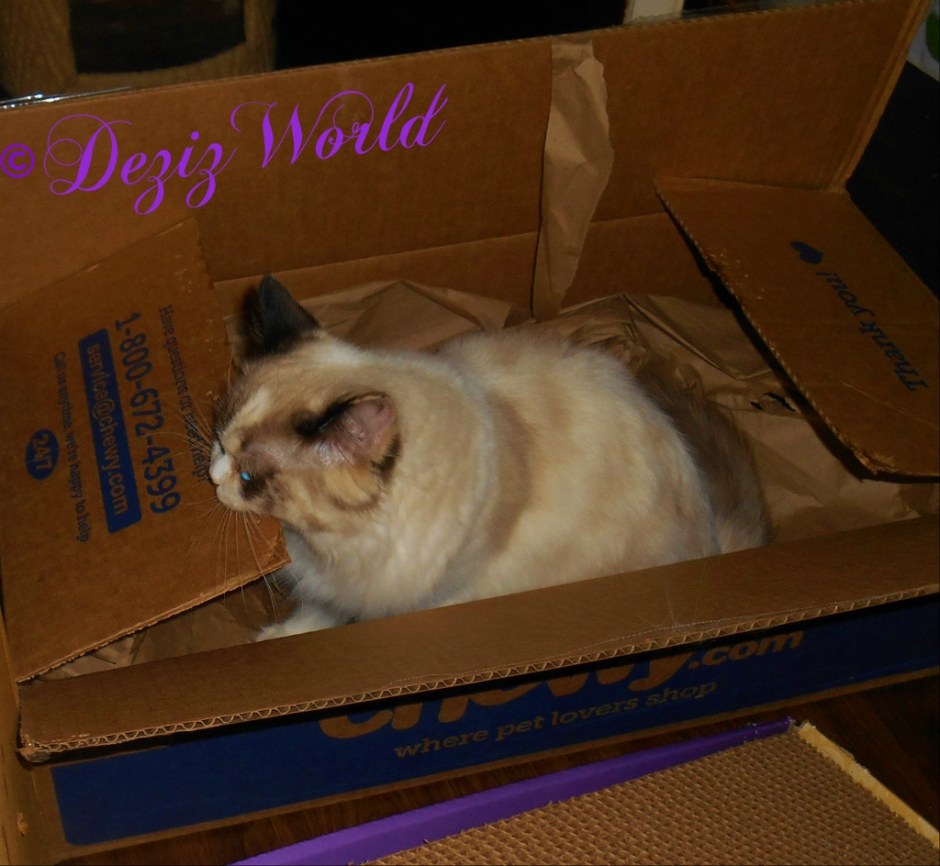
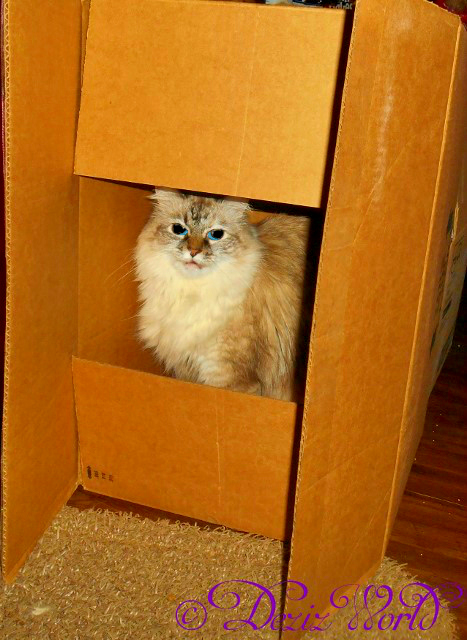
Almost all cats like boxes.
Socializing the Feral Kitty
The next step is socializing kitty. While kitty is sequestered in their “Decompression Room”, you should go in at least a few times a day to spend time with kitty. This excludes the times you come in to clean the litterbox or feed kitty. Anytime you enter kitty’s space, you should talk to kitty and use their name. This doesn’t mean to get into a stare down with kitty or try to pet kitty. Just act like you’re talking to another person in the room and continue on with your business. You can read to kitty, watch t.v. with kitty, sing to kitty or whatever you’d like. Just make sure you’re spending time in the room with kitty. At first, kitty may hide and not show themselves to you at all. Don’t worry, kitty is getting used to your presence and good things happening when you appear. Once kitty starts showing themselves and coming out of hiding in your presence, offer them some treats and/or play time. This may be awkward at first, because the feral kitty is unfamiliar with cat toys and interactive play. Don’t give up on kitty. A little time and patience will reward you greatly.
Signs of Affection
When, kitty finally shows the first signs of affection, Do Not Rush him/her. The first signs will most likely be rubbing against your legs. This is a positive sign. Kitty is accepting you and marking you as part of their family. As kitty continues to offer affection, offer your hand, palm open and facing upwards, below kitty’s head. Allow kitty to sniff your hand and/or rub against it. Do Not try to pet kitty at first. After a few days when kitty rubs against your hand, gently scratch kitty’s chin. At this point, kitty’s motor boat (purr) will probably be on overload. Kitty has now learned to trust you. Do Not Overdo it though. You want to stop petting kitty before kitty gets agitated and retreats. you know the old saying, “Leave them wanting more”.
No Longer Feral
At this point, when you leave the room, leave the door open so kitty may follow you and/or examine the rest of their new territory (your house, their furever home). Go about your normal day and let kitty adjust on his/her own time. Anytime kitty shows themselves and gives you any sign of affection, reward them with treats, praises and/or a quick chin scritch. Altho’ don’t be surprised if kitty returns to the “Decompression Room” when strangers or company appear. Trusting you, took time, and so will trusting the rest of the world. Altho’, kitty may never truly be comfortable with strangers. this can happen with any kitty, not just ferals. If you’re wanting kitty to be a lap cat, place a few treats on the floor and the area beside your lap. Kind of like a trail leading kitty to the desired place, your lap. When kitty crawls into your lap the first few times, ignore them. Yes, kitty can feel your excitement and your heart beating a hundred miles a minute, but don’t give in to the temptation of the pat/scratch. After a few times, you may reward kitty with a nice chin scritch/treat and plenty of praises. Remember to always speak calmly and quietly. Before you know it, you won’t even remember a time when kitty was so afraid they wouldn’t let you see them.
Summary
The rule of thumb is always remember, Repetition, Repetition, Repetition and Rewards. And, Always leave them wanting more. Mommy says that’s a good rule of thumb to follow for even the most sociable kitty. You never want to over-stimulate any kitty to the point where they want to get away from you, bite or scratch.
Well, we’re gonna wrap this up fur now. We do hope this helps. All kitties can be Trained and desire normalcy. Even a Feral can live a happy and contented life as an indoor cat if you take the time to let them learn they can trust humans once again. Don’t furget to leave any questions, comments or blog suggestions below. And, have a pawsum week.
Welcome to another Service Cat Monday. We so totally furgot that mommy had an early ‘pointment today. And, that today is Boxing Day here in the blogosphere. That bein’ said, we’re not gonna leave ya’ hangin’. Let me get the business outta the way so we can get on with it. As with all our Trainin’ posts, the followin’ will be written in human English fur translator and reader ease. Our Trainin’ posts aren’t meant to be a step by step manual, but rather, Tips, Tricks and Techniques mommy has used/developed throughout her many years of animal training, cats in purrticular. Ifin ya’ have any questions or trainin’ questions, purrlease leave them in the comments or send us an email. Purrlease be as specific as pawssible when askin’ behavioral questions. Ifin you have missed any posty in this series, you can ketch up by clickin’ the links at the bottom of this or any Service Cat Monday posty. And always ‘member, Training is all ‘bout Repetition and Rewards.
Well, the last several Service Cat Monday posts have been about dealing with the “Aggressive” Kitty. As we stated last week, that topic is almost unending, but we felt we had covered the issues that had been presented to us and were planning to move on this week. But alas, our sweet friend Valentine left a comment after last weeks post that requires an almost immediate response. The one thing we won’t do, is leave a topic when a kitty or it’s human are in danger or being hurt. And, the reason we’re addressing this here instead of an email is our belief that if one person’s asking, there are more wondering.
After our apartment flooded, we were all packed up and livin’ in
inches fur months befur the remodel was finished and we could get back to livin’.
Let me explain the situation and question as posed to us: A friend is having their house remodeled and one of the 3 indoor kitties is having a very hard time of it and has become “Aggressive”, going so far as to bite and scratch her human. Kitty has been shut in a back room to allow her to decompress, but it’s not really helping. There may also be an outside factor, as there is a family of strays living under the porch. Apparently, kitty has also attempted to escape to the great outdoors.
Fearless sis Lexi cautiously floats on the carpet after the flood while
the noisy fan dryers were blowing.
Well now, sounds like there’s a few problems here, right? The first issue we have, is that we wouldn’t call this kitty’s behavior “Aggressive”. Nor, are we surprised this is happening. As we stated in our previous post, Cats Do Not Like Change or Loud Noises. Having lived through a flood, move, apartment remodel, new roof, new a/c, new hot water heater, and more stranger’s traipsin’ through me’s house than me cares to remember, me’s here to tell you that can really stress a cat out; even one as laid back as us Ragdolls. This is one of those situations, where more information is needed to determine the exact problem. But, we’re going to do our best to help with what we have. Based on the fact this is a remodel and the kitty in question wasn’t presenting this behavior beforehand, we feel pretty safe saying, the feral family under the porch probably isn’t a problem. However, it wouldn’t hurt to feed them a bit further away from the house. We also don’t know exactly where this person lives, but we do suggest providing shelter for the ferals’ away from the house as well. You know, gotta take care of our ferals.
Now let’s get to the heart of this problem, the Remodel. This noise is kind of like the carpet monster (vacuum cleaner), you can’t get rid of it until the job is done. That means, kitty is going to have to learn to live with it. Thankfully, it’s only temporary. Now me knows some of you just said to your selves, What? Your mommy wouldn’t do that to you?. Well folks, let me tell ya’, sometimes, life just isn’t perfect and everybody/kitty has to adjust. What we don’t know, that would really be helpful, is why and when is kitty biting, scratching and trying to escape. A scared kitty will often react with claws and teeth, and that’s what we suspect is happening here. The good thing is this can be fixed.
(While me’s at it, let me give you an example of a “specific”. The workers are in and out and my kitty is trying to run out the door. Or, the workers are hammering and making a lot of noise and my kitty went running crouched down and I grabbed her to put her in the decompression room and she scratched and bit me.)
The Decompression room needs to be a kitty oasis until the remodel is over and the human needs to remain calm and positive when dealing with kitty. The room needs to have a litter box, food, water, cat bed, covered box or cat carrier (with the door open or better yet, off), a few favorite toys, and a well scented piece of clothing. And not the shirt you’re wearing during that fight with the contractor. (MOL) Leave a piece of clothing you were wearing during a time of no stress and happiness. Remember, cats are all about the smell. And trust me, we know happy smell and mad/upset smell. A small perch or cat tree placed near a window would also be good. Before the workers come in the morning, kitty should be taken to the Decompression room for a quick play session and a bite of breakfast. Maybe even a few of those extra special favorite treats you only buy at Christmas and birthdays. Now’s the time to buy them. It would also be good if you could put on some calm music or one of those white noise machines. Or, if you have kitties like us that like to watch teevee, turn on the boob tube (television).
As long as all the cats are getting along, all 3 should be in the Decompression room together. Believe it or not, their presence will help “Scared” kitty to be more relaxed and secure. Make sure there are several hide outs (covered boxes or carriers) available, so all kitties can hide if they need too. If this room is a bedroom, leave the closet door open. Mommy says to please remove any expensive or treasured clothes or quilts. Can you believe we’re not allowed in the closet at all? Anyways, this would be the exception to that rule. And as silly as it sounds, think positively. Yeah, we said it, think happy thoughts. See all of this as a good thing. Tell kitty how wonderful everything’s going to be when all this is over. And each day when the workers leave, let kitty explore and get used to her new territory. Remember, it’s kitty’s newly remodeled home, you just pay the bills. MOL
As for the “trying to escape”, we really don’t have enough information to even guess at a solution. We seriously doubt it has anything to do with the ferals’ under the porch and more likely trying to escape the noise and strangers in her home. But again, we just can’t be sure. It would be irresponsible for us to give a specific answer about that.
We hope we’ve helped a little, and we’re sorry we can’t offer more. The friend is welcome to contact us directly, and we’ll do all we can to help her and kitty. A happy peaceful home is our desire for every kitty in the world. As always, we welcome your questions, comments and post suggestions. And, ifin you’ve missed any of the posts in this series, you can ketch up by clickin’ the links below. As me said earlier, mommy has a ‘pointment today and one tomorrow, so we’ll be ‘round to visit as soon as we can. In the meantime, have a great Boxing Day. Hope you enjoyed our boxing day fotos and a little blast from the flooded past. (See, we can laff ’bout it now).
Welcome, it’s time fur another Service Cat Monday posty. Fank you fur bearin’ with us last week durin’ our time off. Mommy’s not completely thru with lease re-cert stuffs, but she’s gettin’ there. Seems every time we turn ‘round, there’s somethin’ new or old bein’ thrown at us. And, we’ve got an inspection to purrpare fur this week on top of it. Anyways, that’s not what we’re here to meow ‘bout today. As always the followin’ will be writtten in human English fur reader and translator ease. We welcome any and all questions; just leave ‘em in the comments or send us an email. Purrlease be as specific as pawssible ifin you’re dealin’ with a purrticular issue. We want to offur the bestest advice and tips we can to help you and others. Our Trainin’ posts are not meant to be a step by step Trainin’ manual; but rather, Tips, Tricks and Techniques mommy has used/developed throughout her many years of trainin’ animals, cats in purrticular. Remember, Training never stops. it’s all ‘bout Repetition and Rewards. Ifin you’ve missed any of the posts in this series, you can ketch up by clickin’ the links at the end of this or any Service Cat Monday posty.
We’ve been dealing with the issue of “Aggressive” kitties. Unfortunately, Aggression can be the result of so many different issues that we could write about it every day for a year and still not cover it all. However, the base of Aggression is one of three issues: Fear, Illness or what mommy calls Alpha Aggression. Alpha Aggression includes territorial issues and interactions between other dominant cats. In our last Service Cat post, we talked about catering to your Alpha Cat. We got a couple of questions asking what we mean by “catering”. The Alpha cat is always greeted first when coming home or walking into a room where your cats are present. The Alpha Cat should be fed first, get treats first, be brushed first, nails clipped first…You get the idea. Alpha means first/beginning, so the Alpha Cat should get all the firsts. It’s as simple as putting down the Alpha cat’s plate first or saying hello to them first, etc.. It doesn’t mean they get their food and eat and finish before anyone else. And remember, THERE ARE NO BAD CATS!!!
We’ve also covered Scent swapping, Site swapping (when dealing with kitties who are separated from others in a household), Confidence boosting and what drives the behaviors of house cats. Once you’ve ruled out any possible medical reasons for your cats’ behavior, then you need to figure our what’s behind the Aggression in order to treat it. We are all about feeding the strays and feral cats. However, if they are hanging around on your porch, in your backyard, or other areas that could be causing your house kitty to feel insecure or threatened, you need to feed them further away. It can be at the back of your property or a backyard shed. Just keep it off your porch if outside kitties are a problem for your house cat’s well being. As much as we love and pity the kitties who have to live outside, your house cat has to be the priority.
It’s always good to be aware of loud noises that may scare your kitty(s). Obviously you can’t do away with many of those noises, such as the carpet monster(vacuum), lawn equipment, car backfires, and so on; you can eliminate or at least quieten radios, t.v.’s, your voice, etc.. We have a pretty quiet house; and as a result, we get a little scared by loud excited commotion. When somebody comes over, mommy’s always reminding them to act and speak calmly with their inside voice. We may not be able to control the sonic booms, thunder, lawn crew, or the likes, but mommy can control our visitors; and so can you. Even if you think it’s a problem for only 1 cat in your home, it’s really a problem for all if them. Us kitties feed off the energy around us.
Back in the late 70’s early 80’s there was an idea floating around that you could send “psychic” messages to your kitties/animals even when you weren’t at home, to help ease their stress. The idea was to picture your kitty in your mind and say things like, “I love you”, “I’ll be home soon”, “you’re safe”, and so on. While mommy never bought into that idea, she does believe that we kitties/animals can feel your emotions when you’re dealing with us. Whether that emotion is positive or negative, we will react accordingly. When dealing with an “Aggressive” kitty, most of the time, you’re already expecting the worse case scenario when you try to introduce said cat to the other cats in your home. Part of helping your “Aggressive” kitty is getting control over your own pre-conceptions and fears.
This slideshow requires JavaScript.
Due to untimely deaths, mommy’s had a lot of experience introducing new kitties into the house. And because of sis Lexi’s early aggression issues, trust me, mommy had some fears. But, for the sake of all kitties involved, she couldn’t let that fear take control. Mommy believes part of her success in having smooth transitions is her positive , “there won’t be a problem” attitude. And of course, she also believes in the power of prayer. She suggests a little of that visualization to help yourself get past any fears you may have and to make sure you’re approaching the kitties with a positive attitude. Mommy says you need to expect the best instead of the worst when introducing an “Aggressive” kitty to the rest of the house. Be prepared to act swiftly, but expect the meeting to go well. We realize that sounds kind of silly, and is easier said than done, but, it really does work. Especially if you have followed the precursors of Scent and Site swapping and boosting the self confidence of all the kitties in your home.
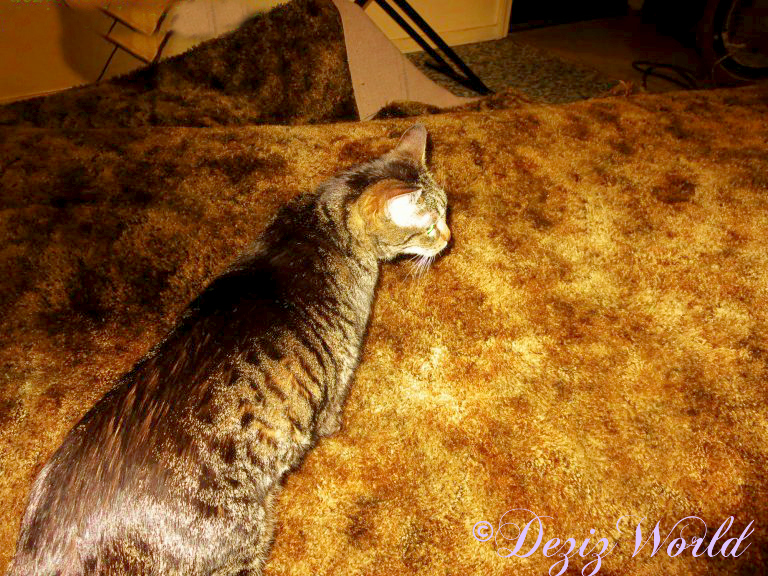
I’s gonna ketch it this time sissy.
The best time to make introductions is after a good play session when all the kitties are tired and a little hungry, especially the more dominant kitties. A good introduction would include some major yummy treats for all kitties. Yes, even those on a diet. It’s necessary for all kitties to be involved in the introductions. If there’s been a problem between 2 specific cats, those introductions should be made separately. If you have a 3rd cat that’s kind of the peace maker, that kitty should be included in that introduction. They may be able to calm the other 2 and serve as a bridge for peace. In the end, a happy cohesive home is the goal. A place where all kitties own their space and co-exist peacefully. We can’t put a time limit on this because every cat is different. You know your cats and they’re yours for life, so take the time to do it right. Your rewards will be endless.
We’re gonna wrap this topic up fur now. We hope we’ve given ya’ some helpful tips to deal with “Aggression” and introductions of kitties. Ifin after readin’ these posts you still need help or would like us to expand on a specific training task, purrlease let us know. As we said earlier, we could cover this topic endlessly and still only scratch the surface. We weren’t given the specifics from any of those who originally asked about Aggression, so we’ve dealt with it in a broad manner trying to help as many as possible. We’ll be addressing a new issue next week, so purrlease come by and check it out. Submit any questions you have in the comments below or send us an email at lexi.dezi@yahoo.com or use the form on our “contact us” page. And don’t furget, you can ketch up on any Service Cat posty you may have missed by clickin’ the links below.












 Service Cats U.S.