Meowllo and welcome to another miserable Monday. It’s time fur another educational Service Cat posty. As always, it will be written in human English. Our blog is not a training manual. Any training tips or stories are not meant to be complete, but rather a starting point; as propurr training takes time and is repetitive. Me wants to thank you all fur your questions and comments on our postys. We were asked ‘bout claw clippin’ a squirmy kitty last week. But it wasn’t da furst time we’s been asked dat, so we’re workin’ on a video tutorial fur dat. You know at da end of da day, we are still cats and have to have our claws clipped just like da rest of ya’; and we’re not so crazy ‘bout it. Mommy’s never hurt us, but still…So we decided a video would be da bestest way to ‘splain how to do it, so stay tuned fur dat. As ya’ know, there’s only one mommy, so these things take time. Ifin you have missed any of da postys in this series, you can get caught up by clickin’ da links below. Some of you have also asked about previous training posts. You can use the search feature on our sidebar to read previous posts. Keywords such as Dezi, wheelchair, phone, etc. will bring some of these up.
Well let’s get started. After last weeks post, we were talking with our friends from Bad Cat Chris about some of the laws that pertain to Service Animals and housing and such. His wife works in the housing/apartment business and is often coming in contact with those “fakers” we’ve talked about. You know, those people who call their pets Service Animals to avoid paying pet deposits/fees or so they can take their pet somewhere pets aren’t normally allowed (ie: stores, restaurants, grocery’s, etc.). You might recall, that every week, we plead with the public to NOT call their pets Service Animals unless they fit the literal description the ADA puts forth; an animal that is individually trained to perform tasks for a disabled person. Fetch, shake, roll over, etc. are not considered Service Animal training.
Your question is probably, “how do these people get away with lying about their pets?” The answer is, Easy. Unfortunately, Certification, is not required by law but rather is voluntary. Because of this there are lots of places that certify animals for a price. Certification really means nothing under the current laws. Per the rules, no one is allowed to ask someone to prove their animal is indeed a Service Animal. The only question that can be posed to a disabled person about their Service Animal is: “What task(s) does this animal perform for you that makes it necessary?” You cannot ask what a person’s disability is or require proof of any kind.
In recent years Companion Animals (CA) have become extremely popular. Remember, a Companion Animal is merely a pet. These animals may also go by the title of Emotional Support Animals (ESA). This means that the very presence of the animal has a positive influence on a person suffering from depression, panic attacks, etc.. A Companion Animal has no specific training and IS NOT a Service Animal. There is no certification or training required for an animal to be considered a Companion/Emotional Support Animal. As a result of studies that prove animals have a positive influence on their owners health, Companion Animals/Emotional Support Animals have gained acceptance and some rights under housing laws. Unfortunately a lot of people take advantage of this, and often try to pass off their CA/ESA as a Service Animal.
Landlords may require a note or letter from a medical professional stating that the animal in question is there to provide emotional support for a person. The animal must still meet the requirements a landlord sets forth in their pet policy. A typical apartment pet policy requires animals be 35 pounds or under, current on all vaccines required by law, well behaved and not a nuisance to neighbors. A landlord may ban pets/CA/ESA from certain areas of the property. Companion Animals/ ESA are not allowed in any public place that does not allow pets (ie: grocery stores, restaurants, etc.).
In an attempt to stop abuse of the Service Animal rights, the ADA refined and limited their definitions of said animals. In doing so, they punished those who truly have a need for a Service Animal of another species than dogs. Another way to go about this would be to require certification for Service Animals. However, that’s not as easy as it sounds. Me thinks this is a lot of information, so me’s going to wrap it up fur today. We’ll talk more about Certification and what effect that would have for the disabled in another post. We were also asked to speak a bit on good training techniques as opposed to bad ones (ie: punishment, force, etc.); so we’ll be covering that in a future post as well. As always, if you have any questions, suggestions or ideas you would like answered or addressed, leave them in da comments or send us an email.
Do you think Certification should be required for all Service Animals?
If you’re for Certification, do you think there should be a charge, and if so, how much?
Meowllo everypawdy, it’s time fur another Service Cat educational posty. As ya’ know da followin’ will be written in human English. It appears there’s still some confusion ‘bout da difference ‘tween Service Animals, Therapy Animals and Companion Animals. Purrlease see our Service Animal page by clicking on da Service Animal tab on our menu bar or click here to read da full definition of each. Me will give a very brief definition of them later in this posty. It’s very purrtant dat everyone understands da differences. Anyways, we got a few good questions to answer today. And we asked a couple questions dat we think you’re gonna be surprised by da answers. Ifin you’ve missed any of da postys in this series you can get caught up by clickin’ da links below.
So let’s get on with it. First up we need to make a few things clear. Mommy talked to one of our friends this past week and learned there’s a lot of confusion about this subject. First and foremost, If you are breeding your non pedigreed cat, that cat is NOT a Service Animal!!! And please STOP!!! Are there not enough unwanted kitties in the world as it is? True Service animals are spayed or neutered for their health and temperament. Now we know a lot of you just said to yourself, “How can you make that judgment and say that?” Well let us explain. If you need a Service Animal, you need said animal all the time. A mother cat will be out of commission for at least 6 weeks, barring complications; her kittens need her more. And most Service animals are not pedigreed animals but rescues. And to breed your non pedigreed indoor kitty is irresponsible at best, but to supply you with barn cats is the very definition of cruel and unusual punishment. And training is not passed on through DNA.
Secondly, we’ll repeat this again. Any Cat at any age can be trained. The number one requirement is the bond you share. Please see the Training Foundation post. It isn’t necessary to start with a kitten. We did because mommy requires 2 cats to help her and there was just me after sis Lexi went to heaven. Introducing a kitten into our home is easier than an adult cat. If you already have a cat or three, you can train one of those. There’s no need to adopt a new cat or kitten or to breed any of your existing cats. We hope that clears a few things up.
Now awnty Jean, Shoko and Kali of the Canadian Cats asked a couple of questions about training. Mommy got a great laugh at the wording of the question, so we’re going to copy and paste it in here for all of you to read. Me must say that mommy and awnty Jean have had many a conversation so she knows mommy pretty well.
Question:Do you ever run across times when Raena just wants to play and is not interested in learning? How long can she get away with not wanting to be taught? Did you ever have a cat that was more interested in playing?
So this question is specifically asked about Raena because that’s who mommy’s training now, but it could apply to any cat or kitten in training. The answer is Yes, of course there are times when Raena just wants to play, she’s a kitten. The trick is to make learning fun so that at least at first she thinks she’s playing. And remember, training is about repetition not a one shot deal. So it’s better to have many short training sessions than one long one. Altho’ mommy makes a game of training for some tasks, it is very serious, and she doesn’t tolerate nonsense. Mommy looks at these times as an opportunity to “train out” unwanted behaviors; such as, hands are not for biting, toes are not for biting, cords are not for biting, etc.. It’s also a time to train kitty to accept being held down, and other things like pilling and bodily exams. These are things that all pet parents could benefit from not just those that are training Service Cats. Unfortunately as kitty ages, there may be a time when medicine needs to be administered, and it’s so much easier if kitty has been trained to accept whatever you do to them as good.
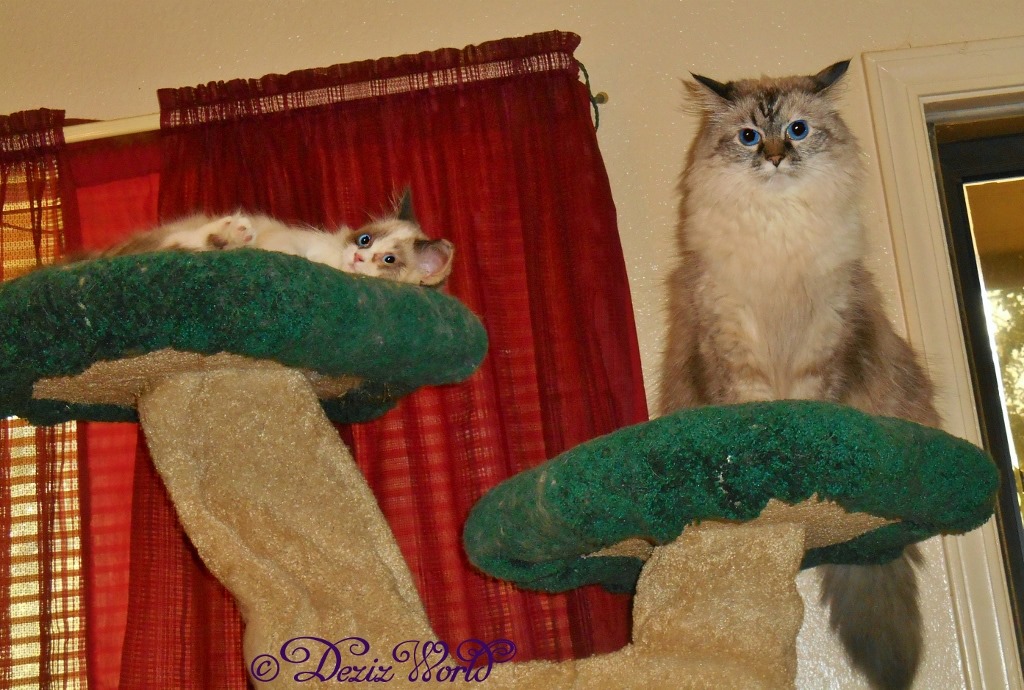
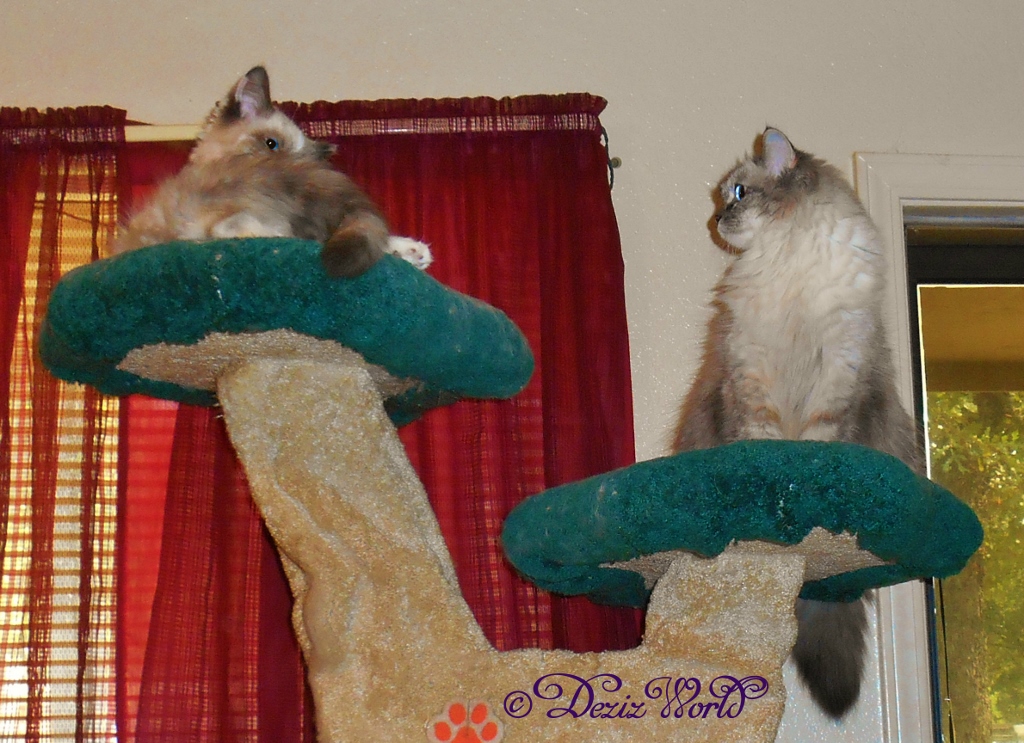
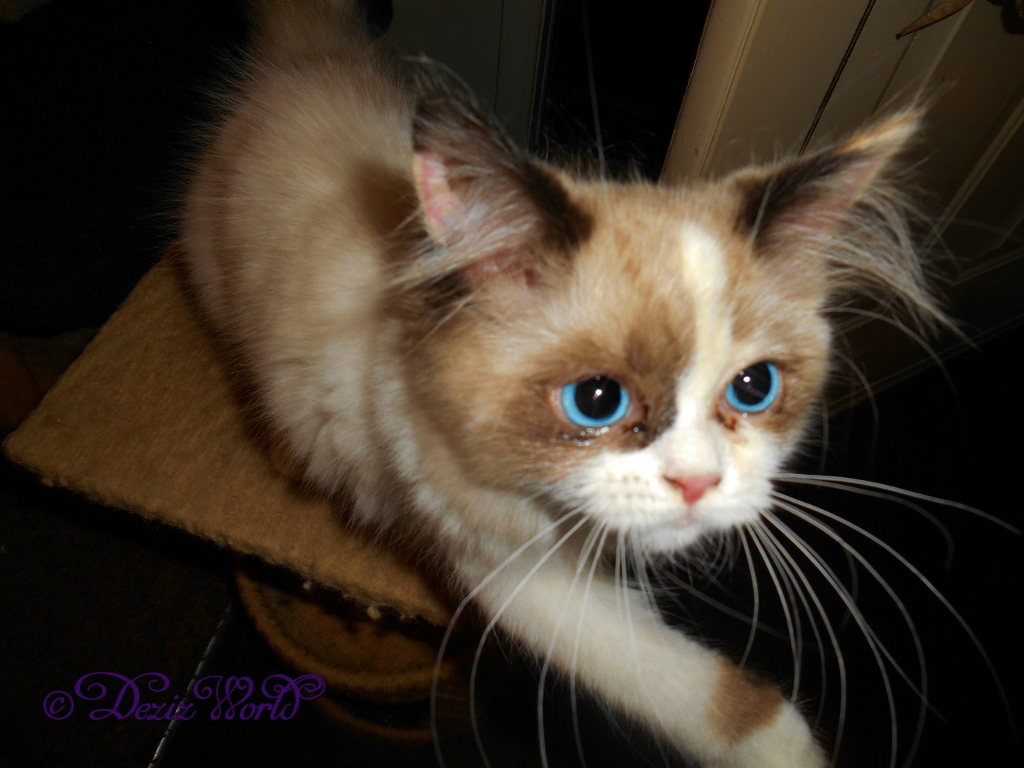
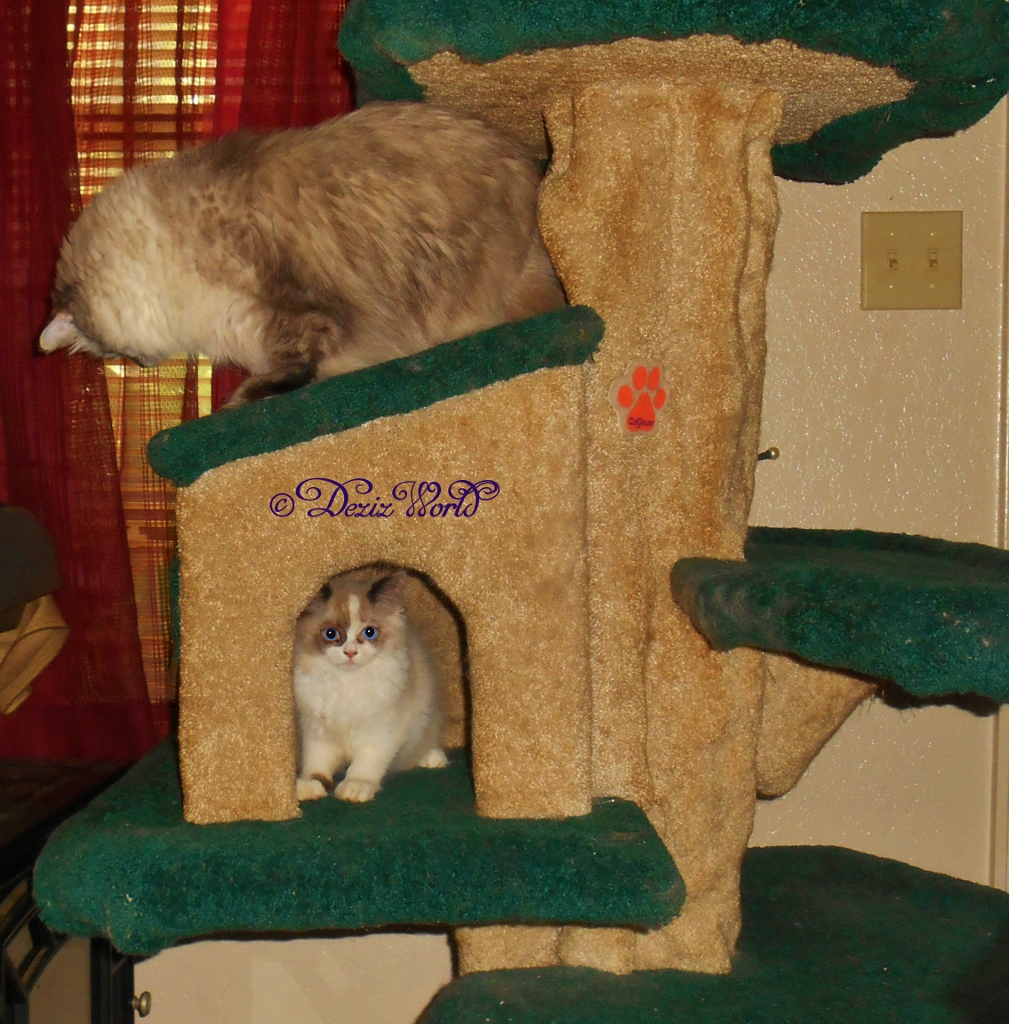
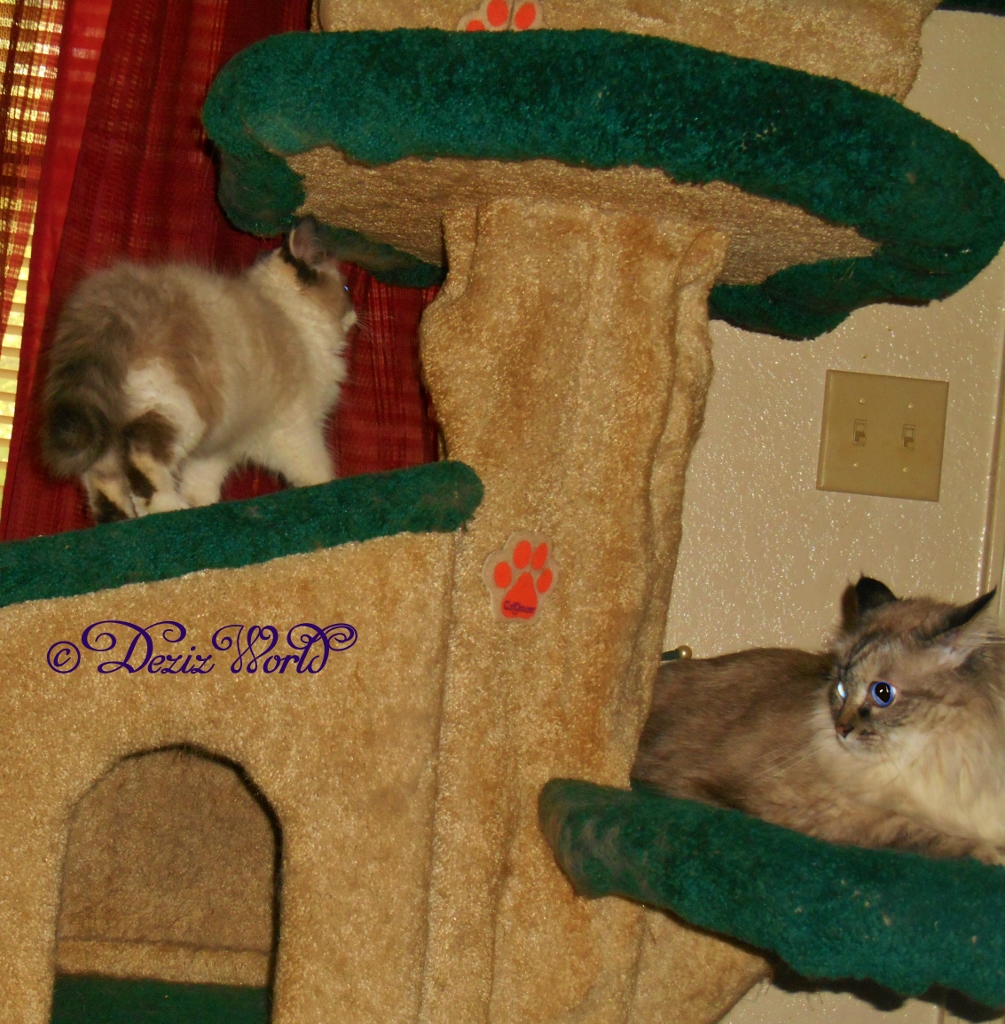
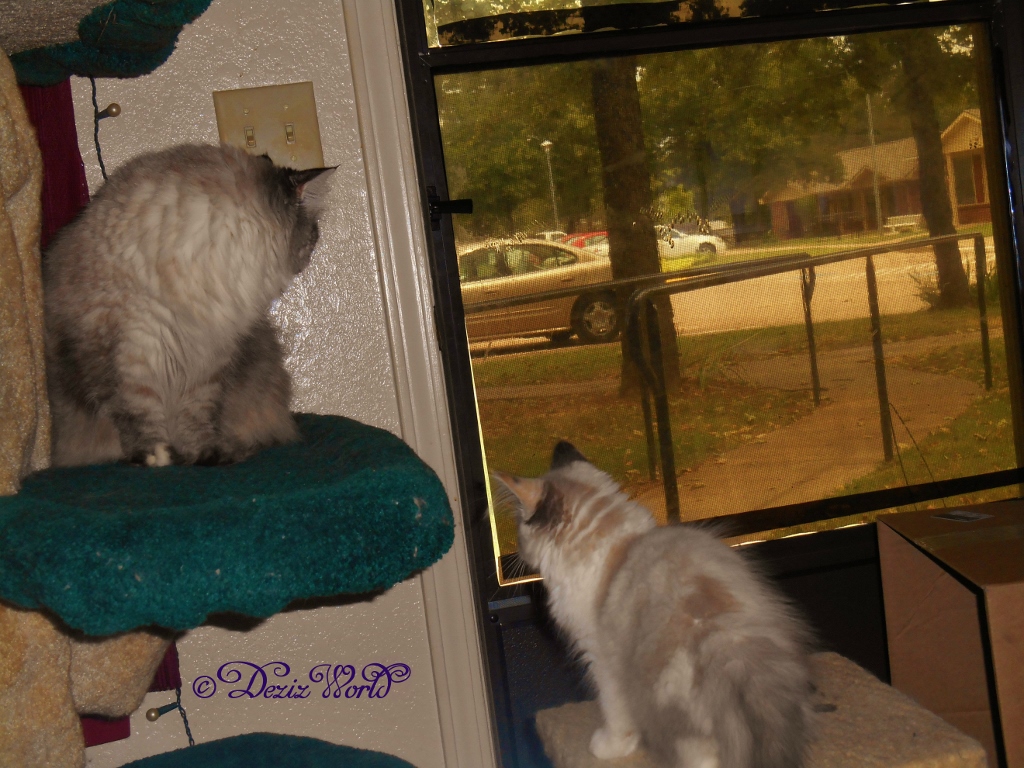
Raena had been playing but jumped on the small cat perch to be closer
to mommy to alert her to sit down. Mommy had been conducting
a photo shoot when Raena and Dezi felt a change and knew
mommy was going to pass out.
Now, we mentioned cost. We asked what you all thought the average cost for a Service Animal is. We also asked who you thought paid for it. We got some mixed answers here, and a couple that mentioned Companion Animals for Service men and women. We realized that most people thought Service animals were given to the disabled free or that some charitable organization paid any fees, and that again, there was some confusion about the differences between Service Animals and Companion Animals. So, here’s a really simple definition of the three classes.
Service animal: An animal that has been specifically trained to perform duties to assist it’s disabled handler/owner.
Therapy animal: An animal that has no particular training other than basic obedience that after certification goes into places like nursing homes, hospitals, etc. to cheer up people by just being there or allowing people to pet it.
Companion animal: A Pet.
These aren’t the full definitions, but hopefully they will help to clear up any confusion anyone still has. Now let’s answer those questions we asked. A few years ago, the average cost of a Service Animal was between $20,000.00 and $50,000.00. This was for a rescue dog purchased through one of the certifying organizations. Dogs trained by individuals could cost exponentially more. Insurance does NOT pay for Service animals. There are organizations one can apply to for financial help, but they’re on a first come first served basis and income based and often require the person in need to pay up to $10,000.00 of the fees. So in the end, the cost of a Service animal is solely on the person needing one. That’s one reason you don’t see more. Most people who need Service animals are on fixed incomes and can’t afford the initial cost. Once a disabled person has a Service animal they can apply to several organizations to receive food and vet care for that animal. These are run by the big pet food companies and are part of their “giving back to the community”. Remember, these organizations only provide for those Service Animals the ADA recognizes as Service Animals.
Anyways, we feel like we’ve given you information overload today, so we’ll wrap it up for now and let ya’ digest all of this. Remember to leave any questions you may have or want answered in da comments or feel free to email us. We’re trying to answer them all as best we can. Raena’s getting’ bigger so she’ll be starting to learn how to use da fone in da next week or so. Mommy’s gonna try to get some good fotos, but since she ain’t da bestest with da camera, we’ll settle fur any fotos. MOL Anyways, da lawn crew’s here. Raena may be fearless, but she hasn’t yet convinced me. Oh, we were asked what mommy did with our fotos in da new editing app yesfurday. She turned our fotos into talking videos.
What would you like to learn (know how to teach your cat or dog)?
How do you feel about the cost of and that insurance doesn’t cover the cost of Service Animals?
Do you think that Service Animals make a difference in the lives of their disabled handlers as opposed to those that don’t have one?
Meowllo everypawdy and welcome to another of our educational postys ‘bout Service Cats. As with all our educational postys da remainder will be written in human English. We got a lot of great questions over da last week, so we thought we’d focus on those today. Purrlease keep da questions comin’. Ifin you missed any of our postys you can read them by clicking on da links below.
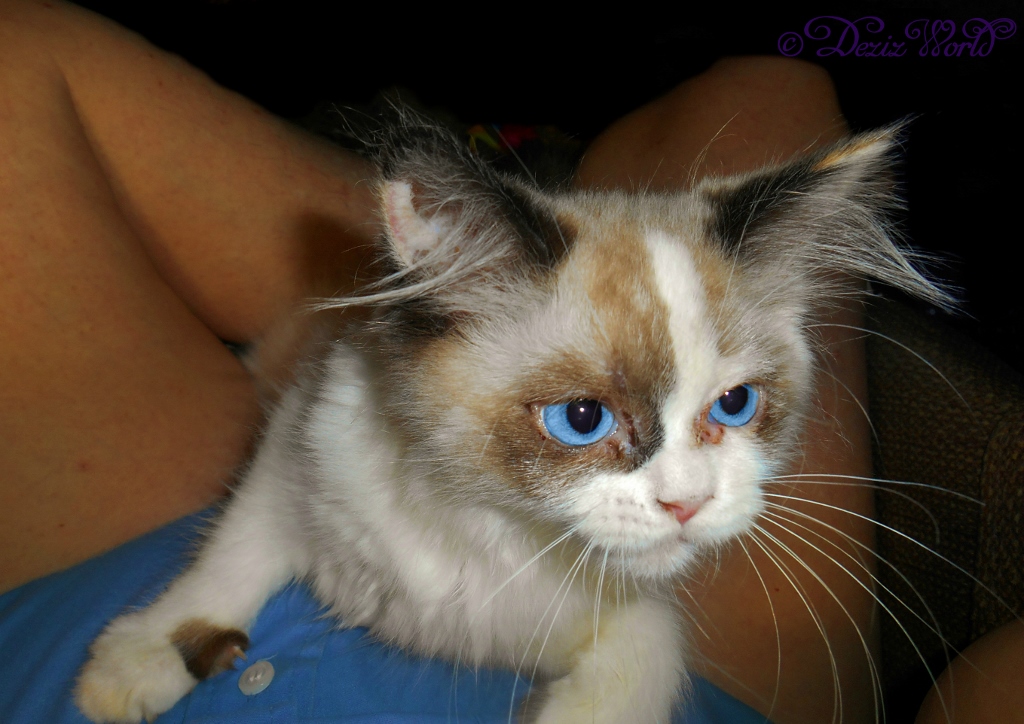
First up tho’ we thought you all might enjoy seein’ Raena pawin’ an alert fur mommy. She was a little confused cuz she’s not used to mommy tryin’ to take a foto of her doin’ it, but dat paw there is on it’s way to pat mommy on da face.
See that paw to the right?
Here’s a close up of that right paw about
to reach mommy’s face to start patting
Okay, let’s get on with da questions. The first question comes from our friends over at Eastside Cats. They ask, Can a Service or Therapy Cat be trained by one person and then go to live with another? That’s a great question, and the answer is a bit convoluted. First let’s address the Service Animal part of that question because there is a huge difference between the 2. As you know most seeing eye dogs are trained and then sold to a disabled person in need. Make no mistake, these charges are outrageous. Anyways, this does cause one to ask the above question. On the one hand the answer is Yes. There are tasks kitty could learn to perform that could then be performed for anyone. For instance, a kitty could be trained to drive a wheelchair or alert to a specific smell, answer a phone, open cabinets, etc. and then placed in the home of a disabled person who has need of those things. Such a kitty would most likely be clicker and treat trained so that they are essentially performing a “trick” on command. There would need to be a few days of additional in home training to get kitty accustomed to his/her new handler and performing the trained tasks for them. (We can’t even begin to imagine the cost of such a kitty.) And the new handler would need to spend extra time bonding with kitty once placed.
Now for the convoluted part of that answer. A kitty trained elsewhere and placed with a disabled person may not actually “work” right away. Unlike dogs, cats aren’t fans of change and do take a bit to feel comfortable in their new surroundings and with their new person/people. Kitty is performing tasks, but is doing so much like a doggy performing sit/stay. There is nothing wrong with this method, but mommy prefers a kitty that performs because they want to help as opposed to one expecting a treat or other reward. Mommy prefers a bonded kitty so that kitty can anticipate and learn what mommy needs as her condition changes.
Now let’s get to the Therapy cat part of that question. A Therapy Cat Does Not perform any specific duties or trained tasks to assist a disabled person. No real training is required to be a Therapy Cat. A therapy animal is one that visits hospitals, nursing homes, etc. with their handler to make people feel good. This can be achieved by letting people pet them, hold them, or just be in the room with them. A Therapy Cat and it’s handler Must attend a training session/seminar to learn the rules on how to prepare for entry into these places and what is allowed and not. Therapy cats and other animals must be bathed regularly, must have a calm and sedate temperament, etc.. Since Therapy Cats and their handlers must attend this training together, then No, Therapy cats cannot be trained by a second hand party. Most of the training for a Therapy Cat is for the human handler. The only real training required for the Cat, is that they be calm and allow people to pet and handle them without scratching or biting. Some breeds are better at this than others. For a full definition/description of Service Animals, Therapy Animals and Companion Animals, please click here.
The next question we were asked is: Would mommy train Service Cats for others? The answer is yes, she has trained cats for others in the past and would consider it again in the future. Depending on the required tasks, mommy may have kitty in training live with us temporarily, or she may go to them. As we’ve said many times, mommy prefers the bonded training method over treat training. And generally when one is disabled their condition get worse through the years and not better. A bonded kitty will adapt and almost train themselves to meet your “new” needs.
We were also asked about a specific condition (Neuropathy) and if a Service Cat massaging them would be of any help and if so could they train their current cat. First we need to state that mommy is not a medical doctor and cannot diagnose anyone’s medical condition. We also cannot determine whether a Service Cat would benefit you if we haven’t met and spent time in person with you. That’s a decision only you and possibly your doctor can decide. We have continually said that any and all cats can be trained, so the answer to that part of the question would be Yes. But we do recommend starting from the very beginning and re-bonding with your resident cat before moving to the next step in training.
This person also asked about training their resident dogs to alert for seizures. Again, without meeting everyone in question we can’t give a specific answer. We will say that the dogs may already be alerting and it’s so subtle no one is recognizing it. And then again, they may not be. We’ll say again that you don’t have to have any particular breed of cat or dog. Altho’ some breeds do make better Service Animals than others. A “smashed faced” cat or dog shouldn’t be expected to scent alert. They can, but but they may not be 100% accurate. A Service Animal must perform their trained tasks every time. Be realistic in your expectations of a Service Animal. People don’t train toy dogs to be guard dogs. Why? Because they’re not scary and can’t deter criminal behavior. So don’t expect the animal or breed you’ve chosen to perform duties beyond their physical capabilities.
The Kitties Blue asked about training massage, but we’ve covered the basics of that in the Training Kitty to Massage post (click link above), so we won’t go over it again here. However, we will expand on it in a future post. They also asked if the trainee had to be a kitten. As we’ve said before, No, any cat can learn at any age. We do recommend starting at the beginning with the bonding process before moving forward with training. And yes, even with your resident cat.
Well, we’re gonna wrap it up fur today. We’ve covered a lot of information here so we’ll give ya’ some time to digest it all. We’ll say in closing that Service animals are Not provided to the disabled for free. The charges, as we’ve stated earlier are outrageous. This is one of the reasons mommy believes in home training. Most disabled people we know live on a fixed income and can’t afford thousands of dollars for a Service Animal. Anyways, we hope you enjoy our post. Please leave any questions you have in the comments. We love hearin’ from you and reading your questions.
Do you (Does your kitty) have the temperament to be a Therapy cat?
Are you still confused about the differences between a Service Cat, Therapy Cat and Companion Cat?
What do you think is the average charge for a trained Service Dog?
Do you think that people who need a Service Animal should have to buy one, or should it be provided for free or covered by insurance?
Meowllo and welvome to another Service Cat posty. As with all our educational posts, the followin’ will be in human English so everypawdy can read or translate it. Me does wanna thank ya’ fur your purrayers, mommy’s feelin’ a little better today. Purrayer changes things fur the better. Alrighty then, let’s get on with our posty. Ifin ya’ missed any of the posts in this series, you can ketch up by clickin’ the links below.
Now that you’re all caught up, we have some great questions to answer today. As you read in a previous post, we alert mommy to a Syncope incident (passing out) before it happens. That alert allows her to get to safety before it happens. Otherwise, she would fall and could seriously hurt herself. We received a couple of questions about this. The first was, what actions do we take to alert mommy. Well when me was a teeny tiny kitten, me could barely reach mommy’s ankles. So, me would “dance” around in a circle and pat her ankles. As me’s gotten older, me’s method has changed a bit. Nowadays, me meows and taps on whatever part of mommy is closest. When we’re out in public and me is in the stroller, me sits up, meows and pats the stroller side that is closest to mommy, since me can’t actually touch her.
Raena has started learning to alert as well. She isn’t nearly as cute as me was, dancing around mommy and patting her ankle, but so long as mommy and her know what’s up, it doesn’t really matter. Raena generally meows and touches mommy with her paw. She’s a little small for the stroller yet, so we’ll have to wait and see how she alerts from the stroller. We’ll get back to you on that one. (FYI: Our stroller zips closed and there are 2 kitten sized escape openings on either side. We don’t have a small enough harness to attach her inside. At this time she would need a ferret harness.)
Now, we told you that we know this because we can smell a change in mommy’s body chemistry. Sick/Disease has a smell. We were asked if dogs could smell this too. The answer is Yes. Most all animals can smell sick, disease and death. There are many Service Dogs that alert to seizures, heart attacks and other illnesses; and more cats and other animal species than the general public is aware of. We don’t have permission to divulge names, but one of our facebook friends has a kitty that has alerted her to seizures for years. And of course you can read in the news at least once a month, about a heroic animal that saved his/her owner from _______(fill in the blank).
Animals are very smart and intuitive. With a little training most of us can serve a purpose and help the disabled. Because of the stereotypes about cats, we often get overlooked when it comes to training and socialization in general and especially being Service animals, Therapy animals and even Companion animals. Contrary to belief, cats can be trained. And for a lot of people we would make the perfect Service Animal. We can and do groom ourselves, use a litterbox, don’t need to go outside or be walked and are extremely affectionate. We are not loners by choice. We love our humans and love to be with them and please them.
Remember when wee told you that Raena is already learning massage? Well, this morning when we woke up, she immediately took her place and started massaging mommy’s arms. ‘Course she is still a very young kitten so after a few minutes, she started jumping around and playing. First off, that’s okay. Remember, fun training is often more successful than yelling at and being stern all the time. There is a time for stern, but it doesn’t have to be all the time. Mommy says that most disabled people have some form or level of depression; so anything that can make you laugh or smile, is a good thing. Not always with a full bladder, but… Anyways, mommy gently spoke to Raena and got her to focus again, and get the blood circulating and the nerves and muscles to wake up in mommy’s arms so we could get up and get our day started.
We would like to put a call out to you all. Do you have or know a Service Cat, Certified Therapy Cat or Certified Companion Cat? As we’ve told you, these are three different categories and shouldn’t be used interchangeably or mistaken for the term pet. Fur the full definitions of each term, purrlease check out our Service Animal tab in the menu bar. We would love to share guest posts about them with everybody. Me’s gonna wrap it up now. The lawn crew’s here, and that means it’s time fur me to nap UTB/C (under the bed/chair). Seems Raena couldn’t care less, but me’s not convinced all that noise is okay. Ifin you have any questions purrlease let us know.
Do you know any Service Animals personally?
Do you have any additional questions about Service, Therapy or Companion animals? (please be specific)








 Service Cats U.S.