Well we finally got a little break from da storms yesfurday and me got to visit a lot of ya’. Dat weather guesser says we should be in fur sunshine startin’ tomorrow afternoon. Me sure hopes so; me hasn’t been fur a stroll in furever. Me did get da sads while visitin’ as there have been quite a few kitties who have joined sis Lexi this week includin’ me’s furiend Spooky from 15 and Meowing. Mommy says da sads are cuz our brains know they’re in a better place now and no longer sufferin’, but our hearts just can’t make sense of it all. Me can attest to da makin’ no sense fur sure. Purrlease lift up and support your furiends, loss is hard on us all.
You know with all da storms we’ve been havin’ lately and knowin’ dat tornado season is comin’ up soon, me had been thinkin’ ‘bout writin’ a posty on disaster purrparedness. We’s posted one befur but we think it’s a really purrtant topic so there’s nothin’ wrong with postin’ every year. And yesfurday one of me’s furiends and fellow cat scouts made dat very suggestion. It’s better to be purrpared and not need it than to be caught in a disaster with nothin’ but da purrverbeal shirt on your back. So dat there’s no confusion, me’s switchin’ to human speak so everypawdy can understand.
As me said, we have tornados, flooding and high winds, but no matter what weather patterns are prevalent in your area the following applies to all disaster/emergency circumstances and all pets.
You should have a First Aid Kit for your pets on hand at all times, and keep it’s contents up to date and fresh. Me will cover what goes in that kit shortly. You should also know which, if any shelters in your area are pet friendly. A lot of shelters are only for humans and only allow Service Animals because of the laws. Please don’t pass your pet off as a Service Animal. You might also want to check for pet friendly hotels/motels in your area. A last resort would be boarding. Check with your VET, shelter, groomers, etc. for boarding facilities in your area and know their policies. Most boarding situations require the animal to be up to date on all vaccinations.
Please don’t leave your pet at home alone in the hopes they will survive and you’ll be reunited. Altho’ they will be stressed, they will be far more comfortable being with you than trying to weather the “storms” by themselves. It’s a good idea to get your pet comfortable with their carrier/PTU before a disaster.
Be sure to have a list of emergency numbers on hand and in your First Aid Kit. Your cell number along with your VETs number and a family members number should be on that list. Keep current photos of all pets on hand and make sure your pet has identification with up to date contact information. Updating your pets microchip information is usually free. We use a company called Pet Link. You can register all your pets microchips with them for a nominal fee; and then all updates are free.
We’ve recently learned that emergency personnel look on the fridge for information about the residents of a dwelling and any medical conditions, etc., so it’s a good idea to put your pets information there as well. Things such as how many and what species of animal lives in your house as well as VET information and any medical conditions/special instructions for them should be listed. Mommy keeps photos of us/me on the fridge and on the back of the photo is our name, age, and any special instructions. In me’s case, it says me is a Service animal named Deztinee, and that me also answers to Dezi. Me’s age and what food me eats is also included along with mommy’s cell phone number and our VETs number. Just in case, mommy also keeps a photo just like this on the front door and in the glove compartment of our car.
The next thing you need is a small bag for your pets that contains at least 3 days worth of food, litter and (disposable) litterbox (for cats and other small animals), water, a favorite blanky/you scented shirt or bed, food and water bowls or paper plates and disposable spoons. A pooper scoop and plastic bags for disposal and a toy or two. Treats and nip are optional. Mommy also likes to keep an extra leash and harness in our bag in case there’s a problem with the one we’re using. Paper towels for clean up, a small washcloth and towel are also handy items to have. Often a hard shell carrier/PTU can double as a litterbox if you use liners in it.
Now let’s get to the contents of that First Aid Kit. You’ll need the following if your going to make your own:
1. Current photos of your pet and any proof of ownership in a plastic baggy. (vet records will suffice)
2. Phone numbers for you, your Vet, and an emergency contact person who is not in your area and might not be affected by your emergency. Phone lines and cell towers may be down.
3. Gauze pads and adhesive tape and/or the sticky wrap
4. Cotton balls and swabs
5. Hydrogen Peroxide
6. Disposable Gloves
7. Scissors and tweezers
8. Antibiotic Ointment and Anti Itch Cream
9. Oral Syringe and/or Turkey baster
10. Alcohol
11. Styptic Powder/Pencil
12. Claw Clippers
13. Artificial Tear Gel
14. Band Aids (mommy keeps a few in our kit for her if she gets bit or clawed while trying to trim claws or care for a wound-they don’t take up that much room)
15. Any medications your pet may need. If your pet is diabetic, you’ll need ice packs. And keep some insulin in an easily grabbable baggie in the front of the fridge, clearly marked for emergencies. Syringes can be kept in your kit or packed bag at all times.
16. Liquid dish soap such as Dawn
17. Flashlight
19. Saline Solution
20. Ice Pack
21. Disinfectant
Be sure to check your kit every 3 months or so for expired items. Always keep your kit fresh and up to date.
Altho’ this is not a comprehensive list, it’s pretty close to it. You can purchase a First Aid Kit instead of making your own, but you will need to add a few things to it especially if your pet requires medications. These kits vary in price depending on where you buy it.
Well me sure hopes this helps. Remember, your pet will be frightened and nervous during a disaster, so any preparations you can make in advance will make this time less stressful for all of you. And trust me when me says, we would much rather be with you than fending for ourselves. Please Don’t leave us behind. You wouldn’t leave a baby or two year old behind…
Well it’s Pet Health month isn’t it? We’s written ‘bout da dental health and spayin’ and neuterin’, and so now we thought we’d give ya’ da 411 on vaccinations. Lots of controversy ‘bout this subject and we’s not gunna put an end to it; but we’s gunna try to purrsent da facts. And of course we’ll give ya’ sum opinions too. Ya’ might member last year when mommy and da VET had a disagreement ‘bout sis Lexi getting da Rabies vaccination, and mommy insistin’ on havin’ a Titer test done to purrove she didn’t need it specially since me had gotten so sick afterwards. They never agreed on what to do, but sissy does have anti-bodies and since she has da CKD and mommy’s makin’ da decisions, she didn’t get vaccinated. Now, cuz we’s cats, we are gunna be coverin’ da Feline Vaccinations. However we do know lots of our readers have doggies as well, so keep in mind dat da recommended vaccination schedule and even sum of da core vaccines are da same fur doggies. Ifin you want more infurmation about Canine Vaccinations click here. And cuz this is such a purrtant subject da followin’ will be in Human speak. So let’s get started.
Let’s start with explaining what a vaccine is. A vaccine can contain recombinant, modified live, or dead attributes of a virus or disease. When introduced into the host body (us cats) it helps build anti-bodies to fight off the disease if exposed. As with any medical procedure there are risks involved in vaccinating. An uncommon but serious side effect of vaccinations is a tumor or growth at the injection site. This is known as FISS, Feline Injection Site Sarcoma. Typically manufacturers state that vaccinations should be given yearly, and quite a few VETs blindly follow those recommendations. However, studies have proven that the protection provided by the vaccines last longer than a year. But before we move on let me explain the difference in the three types of vaccinations.
Dead or InactiveVaccines contain killed or inactive pathogens of the disease and are therefore considered the safest vaccine. Altho’ the inclusion of stabilizers and preservatives have been known to cause both acute and delayed adverse reactions.
Modified Live Vaccines contain intact pathogens that have been modified to provoke an immune response without actually causing the disease. All intranasal and some injectable vaccines contain Modified Live pathogens. In general these are the preferred vaccines as they stimulate immunity faster and longer.
Recombinant Vaccines are made up of certain genetic sequences of a live pathogenic virus combined with the DNA of a live non-pathogenic virus that can be given as a vaccine.
All of these vaccinations are available on the market, but may not be available at all clinics. If you are concerned with which type of vaccine is being given to your pet, you should ask your VET. Mommy insists on Inactive Vaccines when possible and our VET has to special order them because he carries the Modified Live. A fact he didn’t know until mommy asked. His initial response was, “I don’t know what kind of vaccines I give, no one’s ever asked. But surely they are dead.” We found both those statements to be very sad. Just because nobody had ever asked doesn’t mean he shouldn’t have known what he was injecting into his patients. Of course that wasn’t good enough for mommy, she made him check. He has changed some of his vaccines to the Inactive now.
We would be remiss if we didn’t include the fact that a Task Force was formed to study and give recommendations regarding the vaccination schedule for felines due to the adverse effects of vaccines being reported. That being said, the task force recommended that vaccinations shouldn’t be given just because it’s been a year since the last one. The risk factors and lifestyle of the cat in question should also be taken into consideration. Such as age, other health issues, environment, infectious agents and exposure. An inside only cat is at less risk for most diseases than those who go outside or live in a multi cat household. If you board your cat, you may be required to give additional vaccines that wouldn’t normally be necessary. Vaccines should be given to a healthy animal especially when using Modified Live or Recombinant vaccines.
Now that we’ve covered the types of vaccines let’s talk about the actual vaccines. They are grouped into 2 basic types, Core and Non Core. In the State of Oklahoma and many other places there is also the Required by law rabies vaccine.
The Core Vaccines are:
Panleukopenia: Also known as Feline Distemper and is caused by the feline Parvovirus. The virus can remain contagious in litter boxes, cages and bowls for months to years. Infection comes from a cat eating the live virus. Recent studies have shown that the Canine Parvovirus can be contagious to cats as well. The only protection from this disease is the vaccination. The vaccine is available in both the intra-nasal and injectable. The injectable is more effective at preventing the disease. Kittens should receive their first vaccination at 12 weeks with boosters at 16 weeks, and one year. And then no more frequently than every 3 years.
Feline Viral Rhinotracheitis and Feline Calcivirus: Most infectious upper respiratory diseases in cats are caused by the feline herpesvirus or calcivirus. These are transmitted from cat to cat by nose to nose contact or from objects such as food and water dishes. Most otherwise healthy cats will get over these on their own. But others can develop a chronic infection. These cats will have times when they appear totally healthy until they are stressed. At which time they will exhibit signs of the disease such as sneezing, runny eyes and nose. Infected cats will shed the disease for months up to a year and can therefore be a source of infection for others. These vaccines are available in intra-nasal, conjunctival (applied in eye) and injectable. The vaccine ‘Does NOT’ prevent the disease, but will lessen the effects. The injectable vaccine produces the least amount of adverse side effects. Vaccinations should be administered at 8 weeks with a booster at 16 weeks and one year later. Low risk cats should then receive boosters every 3 years.
Rabies: Rabies is mainly transmitted through the bite of an infected animal. Altho the infection can come from any fluid exchange with an open wound from species to species. Rabies is rare in rodents, but can be found in large populations of bats, skunks and other animals. Cats are relatively resistant to rabies but can be a potential source of infection for humans. There is no real treatment for rabies in cats; therefore it is highly recommended that cats be vaccinated. Again, this is the one vaccine that is mandatory by law in our State and many others. The Recombinant Vaccine offers protection with the lowest percentage of side effects. It is recommended that kittens receive the killed or recombinant vaccine at 12 to 16 weeks of age and then yearly boosters unless you are using the 3 year vaccine. Check your local laws regarding what is acceptable.
Feline Leukemia: Feline Leukemia can be transmitted by saliva, nasal discharge, biting, and/or sharing food and water dishes. It can also be transmitted by a mother to her kittens in utero or through her milk. Kittens under 16 weeks of age and cats living in catteries or large households where the virus is present or who go outside are at the highest risk and vaccination is recommended after a blood test. A blood test is performed before vaccinating because a vaccinated cat will test positive. There are potentially serious side effects associated with this vaccine. They can include local swelling or pain, lethargy, fever, post vaccination granuloma (benign lump) and most seriously, Vaccine Associated Sarcomas. A Sarcoma is a mass comprised of cancerous cells that can migrate from the injection site to other connective tissue, muscles and bone. Even with treatments and surgical removal their have been cat deaths associated with vaccination Sarcomas. That being said, vaccine manufacturers have made many strides towards safer vaccines in latter years. Vaccination Sarcomas are rare in comparison to the risk of infection of Feline Leukemia. Vaccination is recommended at 8 to 12 weeks with a booster at 16 weeks an then yearly.
So, those are the Core vaccines. With any adult cat of unknown origin, all Core vaccinations should be given immediately.
Non Core Vaccines:
Chlamydiosis: Chlamydia Psittaci is a bacteria affecting the eyes and respiratory tracts. It is easily cured with appropriate antibiotics.
Feline Infectious Peritonitis: FIP is caused by Feline Coronavirus. It is more common in crowded, overpopulated, dirty conditions and cats who become infected rarely survive. The vaccine currently available has been studied and shows no proof that it indeed offers any protection.
Dermatophytosis: In plain English that means Ringworm. Ringworm is caused by a fungus and can be easily treated. The current vaccine has not proven to offer protection.
Bordatella Bronchiseptica: This bacteria infects the respiratory tract and is most often resolved on it’s own in an otherwise healthy animal.
Giardia: Giardia is a protozoan parasite that attacks the intestinal tract. Infection usually comes from drinking contaminated water. The vaccine hasn’t shown evidence of offering any protection.
Feline Immunodeficiency Virus: FIV is highly contagious and testing is recommended before introducing any new cat to the home. FIV is often referred to as Feline AIDS because it weakens the cats immune system. There is NO CURE for FIV. However, FIV positive cats can lead an otherwise normal happy life but care must be taken if they are sharing their home with FIV negative cats. Cats should be tested prior to vaccination because they will test positive after the vaccination. It should also be noted if a cat has been negative and vaccinated because of the false positive results that will show up in the future. The current vaccine has no studies to prove that it is effective.
Well if that isn’t information overload me doesn’t know what is. But we wanted to be thorough and fair in purrsentin’ the facts. Now fur some opinions. We’ve been asked a lot how we feel or what we think about vaccinations and if there are any we think are more important than others. And mommy’s opinion has changed over the years. You know way back when she followed the advice of the manufacturers and VETs she was a yearly vaccinator of all available. Yep, she even had one kitty vaccinated for Ringworm when he was 16 weeks old. He never got ringworm, but he also was never exposed. With the onset of studies and increased knowledge, and looking for a more natural approach, mommy no longer believes in vaccinating every year. We believe it’s very important to have all new kittens vaccinated with the Core Vaccines according to the schedule of 8 to 12 weeks, 16 weeks, and one year as well as spayed or neutered by 7 months. We also think it’s very important to have all adult cats of unknown origin vaccinated with all the Core Vaccines as soon as possible as well as spayed or neutered if necessary. We believe that vaccines should only be given to healthy animals thus mommys disagreement with our VET over sis Lexi getting vaccinated. If Fido or fluffy has a cold, wait a week or two. If they have a chronic ailment like sissy with the CKD, talk with your VET. Hopefully you have a better one than us and won’t be arguing over it.
Ain’t I a cutie?
Yes there are risks involved in vaccinating, but the diseases they help prevent are awful and unnecessary. As we said early on, Vaccines last longer than the one year manufacturers’ list. So after the initial yearly booster, we are vaccinated every third to fourth year with Panleukopenia. We are vaccinated against Rabies every 3 years but only because it’s required by law. Being Service Cats we do go into the public, but are protected from outside influences because we are in a covered stroller which doesn’t interfere with our duties for mommy. We are indoor only cats who are not exposed to other diseases or infectious pathogens and we initially tested negative for contagious diseases. Mommy does like to repeat the tests for a total of 2 times before initial vaccinations. Kittens can be tested as young as 6 weeks of age. We were both tested at 6 weeks and 9 weeks and then given our first round of vaccinations. For all older cats and cats with chronic ailments, we highly suggest talking with your VET about your cats lifestyle and what vaccinations may or may not be necessary. And there is always a Titer test available if antibodies are in question.
Me knows you wanna rub me’s floofy belly, don’cha’!?
We are cats. We don’t like to go to the VETs and we don’t like to be poked and prodded. But it is up to our humans to do what is best fur us whether we like it or not. Even if you choose not to vaccinate your pet, it is still necessary to have them examined at least once a year. We do recommend single vaccinations. It means more sticking but if your animal has any adverse reactions at least you’ll know which vaccination caused it. And if your pet has any side effects to vaccinations they should be reported to your VET and the vaccine manufacturer immediately. So there ya’ have it. We hope we’ve maybe cleared up some of the confusion you might have been having about vaccinations. If you have any questions, of course you may leave them in the comments and we’ll try to find an answer for you. Or you can check out the many articles online. There’s a great PDF put together by the Feline Vaccination Advisory Panel here. Me’s tired now, so me’s gunna go take a nap. And since mommy had to do all da typin’ fur me, she’s tired too. We’ll be by to visit ya’ as soon as we rest up a bit.
How often do you vaccinate your pets?
Do you know what type of vaccine your VET uses?
Are you worried about the side effects of vaccinations?
5 Ways To Help Your Pet Get Through the Grieving Process
Mommy why duz it have to get cold outside? Why duzn’t da sun always shine? Why don’t all kitties have a home? Mommy, why do our furiends have to die? And why duz me feel so sad when they do?
Oh Dezi you sure are full of questions today aren’t ya’? Honey, I don’t know why our friends have to die. I mean, I know that death is part of life, and the Bible says that it’s appointed unto man but once to die. (Hebrews 9:27) And that means all creatures who live on this planet, including our friends baby. Sometimes they just get old and their body gets tired and just can’t go on. And sometimes they get sick and there is no cure for what they have. And sometimes as awful as it is there are accidents that take our friends way before their time. Us humans have control over a lot of things, but only God controls life and death. God allows us all a chance to live and find happiness like we have with each other; until the day He calls us back to heaven. Our friends in heaven are no longer sick or old or in pain. As much as we loved them and wanted them to be a part of our lives forever, they are in a far better place now. The sads we are left with are called grief honey.
Grief comes in stages and no one can escape going through them. For humans the five stages of grief are:
1. Denial
2. Anger
3. Bargaining
4. Depression
5. Acceptance
But animals grieve as well and we, your care takers should be sensitive to that. When an animal bonds with another animal or human, they grieve the loss of that animal or human. Grief in animals can be harder to spot because often the changes are subtle and can range in severity. Some of those changes are:
1. Appetite (eating less or not at all)
2. Becoming more or less vocal
3. Appear lost or confused
4. Wandering in an attempt to find their lost companion
5. Change in sleep patterns (sleeping more or less)
6. Spending more time with a toy or item used/favorited by their lost companion (clothing, blanket, bedding, etc.)
7. Becoming more clingy to remaining household members
8. Acting Out
These are just a few symptoms of grief in animals. As humans we must pick up on these subtle changes and do what we can to help you get through the grieving process. A few ways we can help are:
1. Let survivors view the body of their lost loved one. ( funerals are for the living. A last chance to say goodbye and accept the finality of a loved ones’ passing.)
2. Spend extra quality time with the surviving pet(s). Grooming, longer walks and more playtime are just a few ways to spend that extra time.
3. Maintain your routine as closely as possible.
4. Maintain discipline for those pets that act out.
5. Depending on the severity of grief, adding a new animal to the household might be more stressful. Know your pets, you will be the best judge of when it’s time to bring home a new furry friend.
Although you can’t speed up the grieving process, remember that cat’s shouldn’t go without food for more than 24 hours before it starts affecting their health. And if this process drags on, a trip to the vet might be called for to make sure there’s nothing physically wrong. Animals, just like humans will get through it. God has given us all the capacity to love, accept loss and love again. And also remember your anipals pick up on their humans’ emotions.
Fank you mommy fur takin’ da time to explain what meez sads are and how to help us anipals get fru it. Me hopes this will help meez furiends too. We have lost so many furiends this year and it’s still January. Me wants it to stop, but at least now me knows dat they are goin’ to a better place and dat me can get over da sads. Weez joinin’ Rascal and Rocco fur da Pet Parade and tomorrow weez’ll be sharin’ meez Carwood Derby entry fur Cat Scouts. Weez changin’ da day we share our adoptable furiends so stay tuned.
Do you know any other ways to help you or your pets get through the grieving process?
Well here we are with da final part of our mini series on Sterile Cystitis. In our furst post we talked ‘bout da pawssible causes. Our second post innerduced you to meez new food. We discussed da pawssibility dat Sterile Cystitis was partly caused by food, both dry and those containing too many carbohydrates which kitties systems can’t break down. Seems Veterinary medicine doesn’t actually know what causes Sterile Cystitis. But thru comparin’ da lives of those cats purrsentin’ with it they’ve made sum assumptions. Another of those is dat it be caused by stress.
Get yous coffee, tea or whatever and sit back and let us splain what be workin’ fur us.
Well anypawdy who knows kitties knows dat we can get purrlenty stressed purretty quick over nothin’. And as most cat peeps know a kitty offen shows their stress thru their urine habits.Anyways, stress can be caused by numerous things like funder boomers. Or maybe a change in our house hold. You know, did you move dat chair from da livin’ room? Or did you bring home a new kitty or doggy? A new baby, a move, a new man or woman in your life, new work schedule or just plain ole boredom can cause your cat stress among other things.
So mommy changed meez food and gave me a supplement dat we found at Wysong to help lower meez urine pH, and then we had to work on meez stress levels. Meow mommy dat’s a lot of stuff to do.
Well baby there’s nothing I wouldn’t do for you. And yes, we did start with getting you off the Blue Buffalo kibbles, but knowing you were in pain, hurt me too and I wanted to get your urine pH down as quickly as possible. When I started my research we ended up at the Wysong website but not because of their food. That was a bonus. Wysong makes 2 supplements for urine pH. Both are called Biotic pH. There’s one for acidifying the urine and 1 for alkalizing the urine. Since Dezi’s urine pH was around 8-9 we needed to get it back down to the normal range. Having a urine pH that high meant she was at risk for developing stones and blockages. Ideally I would like to have Dezi do fine without any additional supplements, but as with medicines and supplements, sometimes you give something to get over a problem and then reassess. Thankfully the supplement is a powder that was sprinkled over her food and readily accepted. She ate it like a kid eats candy. But how do we know if it’s working?
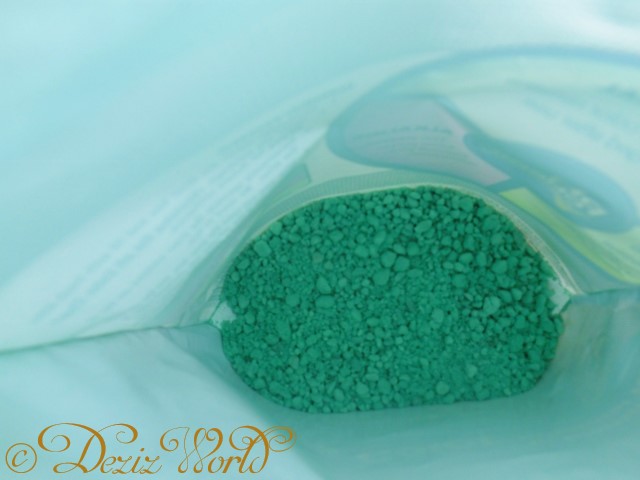
To determine if Dezi’s urine pH was returning to normal we needed to test it. That meant either going back to the vet and paying for another urinalysis or testing it myself. Thankfully many advancements have been made in urine testing for cats because Dezi is the cat that would refuse to pee if I were standing there holding a test strip under her while she used the litter box. I researched testers extensively as well as ways to collect the urine and finally settled on a litter additive. Simple Solution makes a product that specifically tests urine pH when mixed with any litter you currently use. Since Sterile Cystitis can be an ongoing issue, and we’ll need to keep an eye on Dezi’s urine pH, I bought a couple of bags to start.
Those little green things be da Simple Solution.
I poured some Simple Solution crystals in the area where Dezi urinates and waited (they are now mixed in throughout the litter which will happen with the cats’ digging and does not affect the accuracy of the crystals or their ability to work). I didn’t have to wait long because the additive seemed to intrigue her. When she left the box, I was holding my breath. Dezi had been on the new food and supplement for a couple of days. I know you’re all thinking it was too soon and I was expecting a miracle. Maybe I was. I believe in miracles and so many people had been praying for her, so I checked the litter. Alright, it wasn’t perfect. It was a nice shade of lilac, not the color I wanted. But it had only been a couple of days, and at least it wasn’t deep purple which is where it would have been the day she was diagnosed. Another meal down, more fluids and the next time Dezi used the litter box the crystals didn’t change color at all. We were there. Her urine pH was finally normal again. My little girl was no longer in pain. Insert in your mind, a photo of mommy smiling from ear to ear with tears of joy streaming down my face.
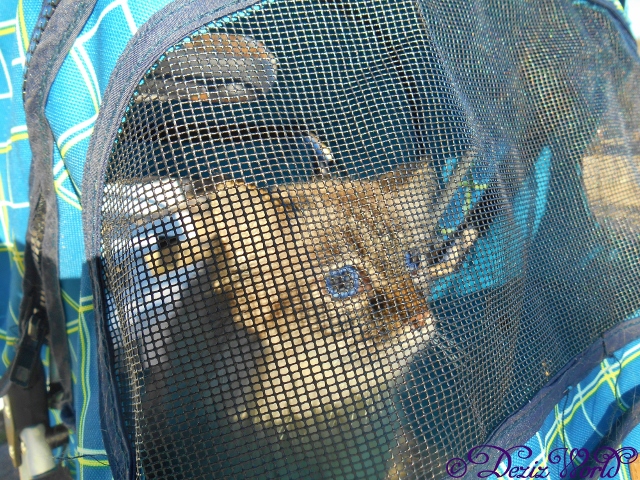
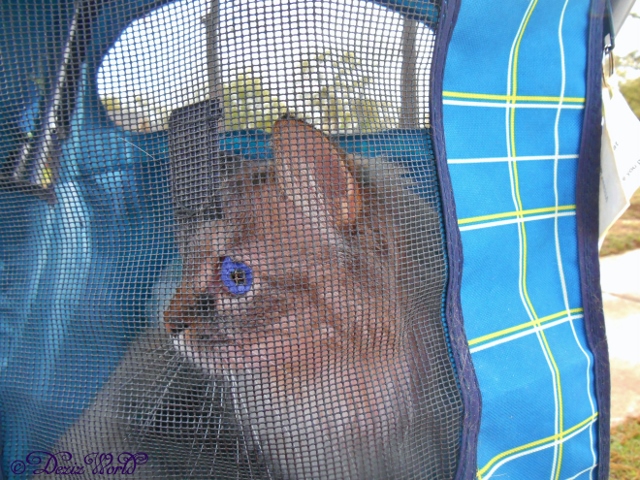
The next step was and is to work on Dezi’s stress levels. To do that we’ve been taking some days off the computer to hang out together and play and go for strolls. Dezi loves to play and she really likes to go out and see people and things. Kitties that lay around and sleep all the time can be stressed. Altho’ cats do sleep more than most species, they need enrichment during their waking hours. Their ancestors had to hunt for their food, so a little playtime before a meal can be beneficial. And altho’ I don’t believe any cat should be outside unattended, there’s a benefit to fresh air and sunshine. So invest in a good harness and leash and take the time to train your cats to use it. I have always preferred those harnesses made more like clothing as opposed to the strappy ones. A cat feels more secure when wrapped and even tho’ they may not like the harness at first, they will grow accustom to it and even someday enjoy it. We also use a stroller for going out. I’ll tell you they are a great investment. A way to take kitty out while keeping them completely protected.
The last thing we added is a calming aid. Some of you know we’ve tried the Thundershirt, Feliway and Bach’s Flower Essences, as well as a few other brands of treats and drops to no avail. Dezi hates storms, the lawn crew, fireworks, and most other loud and obnoxious noises. I searched and read and even made calls looking for something that might work. I will say that we don’t know if any of the calming treats on the market actually work because Dezi won’t eat them. When it comes to treats, she only wants freeze dried meat and unfortunately nobody makes a calming freeze dried chicken breast treat.
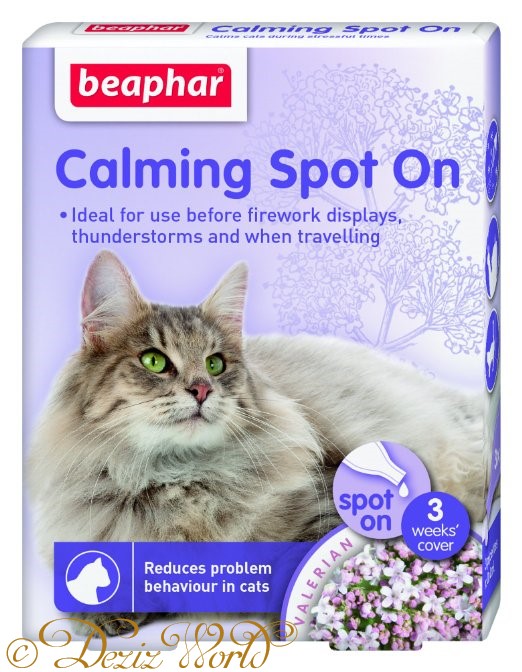
Anyways, we found a spot on from a company across the pond on amazon called Beaphar. They make calming collars, pills, and a spot on that is supposed to work for a week, among other products. The only ingredient in this spot on is Valerian. It comes in a box of 3 tubes much like a flea treatment. Instead of applying between the shoulders, this is applied between the ears and becomes effective within an hour of application. We’ve had a few storms since we started using it, and Dezi did much better. She did finally hide, but not at the first sign or crack of thunder. And she came out when I called her. I didn’t expect a spot on to work miracles; and part of being calm during these stressful events is acclimation. If Dezi has something that can help keep her calm long enough she can become accustomed to them and eventually not hide at all.
So all in all I’m happy with the results. I don’t like the price, but is there anything we won’t do for our babies? Right now a box of 3 Beaphar Calming spot on is selling for $7.50 – $10.00. The first ones we bought were $14.00. So the price varies and is a bit high, but the product works. If you’re having trouble and the other calming products don’t work for you either, then you might want to give this a try. I would like to note that we purchased all of these products ourselves.
Fanks fur ‘splainin’ everything mommy. Me luvs da new food. And mommy wanted me to tell ya’ dat me dusn’t take da Biotic pH – anymore, but will again ifin me needs it. And da little green crystals in meez pawdee box awe kinda cool. As fur da spot on, meez not sure me likes havin’ an oily head fur a day, but hey, those storms don’t seem quite as bad anymore. And meez really luvvin’ da extra time weez spendin’ togevver. Me luvs you mommy, and fanks fur duin’ so much to make me well.
As we do every weekend, weez joinin’ Rascal and Rocco fur da Pet Parade. And stay tuned Monday cuz weez gunna be havin’ a give away.












 Service Cats U.S.