Meowllo and welcome to another miserable Monday. It’s time fur another educational Service Cat posty. As always, it will be written in human English. Our blog is not a training manual. Any training tips or stories are not meant to be complete, but rather a starting point; as propurr training takes time and is repetitive. Me wants to thank you all fur your questions and comments on our postys. We were asked ‘bout claw clippin’ a squirmy kitty last week. But it wasn’t da furst time we’s been asked dat, so we’re workin’ on a video tutorial fur dat. You know at da end of da day, we are still cats and have to have our claws clipped just like da rest of ya’; and we’re not so crazy ‘bout it. Mommy’s never hurt us, but still…So we decided a video would be da bestest way to ‘splain how to do it, so stay tuned fur dat. As ya’ know, there’s only one mommy, so these things take time. Ifin you have missed any of da postys in this series, you can get caught up by clickin’ da links below. Some of you have also asked about previous training posts. You can use the search feature on our sidebar to read previous posts. Keywords such as Dezi, wheelchair, phone, etc. will bring some of these up.
Well let’s get started. After last weeks post, we were talking with our friends from Bad Cat Chris about some of the laws that pertain to Service Animals and housing and such. His wife works in the housing/apartment business and is often coming in contact with those “fakers” we’ve talked about. You know, those people who call their pets Service Animals to avoid paying pet deposits/fees or so they can take their pet somewhere pets aren’t normally allowed (ie: stores, restaurants, grocery’s, etc.). You might recall, that every week, we plead with the public to NOT call their pets Service Animals unless they fit the literal description the ADA puts forth; an animal that is individually trained to perform tasks for a disabled person. Fetch, shake, roll over, etc. are not considered Service Animal training.
Your question is probably, “how do these people get away with lying about their pets?” The answer is, Easy. Unfortunately, Certification, is not required by law but rather is voluntary. Because of this there are lots of places that certify animals for a price. Certification really means nothing under the current laws. Per the rules, no one is allowed to ask someone to prove their animal is indeed a Service Animal. The only question that can be posed to a disabled person about their Service Animal is: “What task(s) does this animal perform for you that makes it necessary?” You cannot ask what a person’s disability is or require proof of any kind.
In recent years Companion Animals (CA) have become extremely popular. Remember, a Companion Animal is merely a pet. These animals may also go by the title of Emotional Support Animals (ESA). This means that the very presence of the animal has a positive influence on a person suffering from depression, panic attacks, etc.. A Companion Animal has no specific training and IS NOT a Service Animal. There is no certification or training required for an animal to be considered a Companion/Emotional Support Animal. As a result of studies that prove animals have a positive influence on their owners health, Companion Animals/Emotional Support Animals have gained acceptance and some rights under housing laws. Unfortunately a lot of people take advantage of this, and often try to pass off their CA/ESA as a Service Animal.
Landlords may require a note or letter from a medical professional stating that the animal in question is there to provide emotional support for a person. The animal must still meet the requirements a landlord sets forth in their pet policy. A typical apartment pet policy requires animals be 35 pounds or under, current on all vaccines required by law, well behaved and not a nuisance to neighbors. A landlord may ban pets/CA/ESA from certain areas of the property. Companion Animals/ ESA are not allowed in any public place that does not allow pets (ie: grocery stores, restaurants, etc.).
In an attempt to stop abuse of the Service Animal rights, the ADA refined and limited their definitions of said animals. In doing so, they punished those who truly have a need for a Service Animal of another species than dogs. Another way to go about this would be to require certification for Service Animals. However, that’s not as easy as it sounds. Me thinks this is a lot of information, so me’s going to wrap it up fur today. We’ll talk more about Certification and what effect that would have for the disabled in another post. We were also asked to speak a bit on good training techniques as opposed to bad ones (ie: punishment, force, etc.); so we’ll be covering that in a future post as well. As always, if you have any questions, suggestions or ideas you would like answered or addressed, leave them in da comments or send us an email.
Do you think Certification should be required for all Service Animals?
If you’re for Certification, do you think there should be a charge, and if so, how much?
Meowllo and welvome to another Service Cat posty. As with all our educational posts, the followin’ will be in human English so everypawdy can read or translate it. Me does wanna thank ya’ fur your purrayers, mommy’s feelin’ a little better today. Purrayer changes things fur the better. Alrighty then, let’s get on with our posty. Ifin ya’ missed any of the posts in this series, you can ketch up by clickin’ the links below.
Now that you’re all caught up, we have some great questions to answer today. As you read in a previous post, we alert mommy to a Syncope incident (passing out) before it happens. That alert allows her to get to safety before it happens. Otherwise, she would fall and could seriously hurt herself. We received a couple of questions about this. The first was, what actions do we take to alert mommy. Well when me was a teeny tiny kitten, me could barely reach mommy’s ankles. So, me would “dance” around in a circle and pat her ankles. As me’s gotten older, me’s method has changed a bit. Nowadays, me meows and taps on whatever part of mommy is closest. When we’re out in public and me is in the stroller, me sits up, meows and pats the stroller side that is closest to mommy, since me can’t actually touch her.
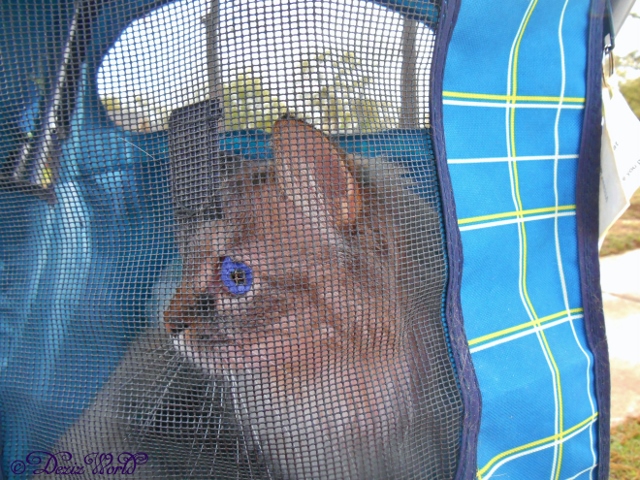
Raena has started learning to alert as well. She isn’t nearly as cute as me was, dancing around mommy and patting her ankle, but so long as mommy and her know what’s up, it doesn’t really matter. Raena generally meows and touches mommy with her paw. She’s a little small for the stroller yet, so we’ll have to wait and see how she alerts from the stroller. We’ll get back to you on that one. (FYI: Our stroller zips closed and there are 2 kitten sized escape openings on either side. We don’t have a small enough harness to attach her inside. At this time she would need a ferret harness.)
Now, we told you that we know this because we can smell a change in mommy’s body chemistry. Sick/Disease has a smell. We were asked if dogs could smell this too. The answer is Yes. Most all animals can smell sick, disease and death. There are many Service Dogs that alert to seizures, heart attacks and other illnesses; and more cats and other animal species than the general public is aware of. We don’t have permission to divulge names, but one of our facebook friends has a kitty that has alerted her to seizures for years. And of course you can read in the news at least once a month, about a heroic animal that saved his/her owner from _______(fill in the blank).
Animals are very smart and intuitive. With a little training most of us can serve a purpose and help the disabled. Because of the stereotypes about cats, we often get overlooked when it comes to training and socialization in general and especially being Service animals, Therapy animals and even Companion animals. Contrary to belief, cats can be trained. And for a lot of people we would make the perfect Service Animal. We can and do groom ourselves, use a litterbox, don’t need to go outside or be walked and are extremely affectionate. We are not loners by choice. We love our humans and love to be with them and please them.
Remember when wee told you that Raena is already learning massage? Well, this morning when we woke up, she immediately took her place and started massaging mommy’s arms. ‘Course she is still a very young kitten so after a few minutes, she started jumping around and playing. First off, that’s okay. Remember, fun training is often more successful than yelling at and being stern all the time. There is a time for stern, but it doesn’t have to be all the time. Mommy says that most disabled people have some form or level of depression; so anything that can make you laugh or smile, is a good thing. Not always with a full bladder, but… Anyways, mommy gently spoke to Raena and got her to focus again, and get the blood circulating and the nerves and muscles to wake up in mommy’s arms so we could get up and get our day started.
We would like to put a call out to you all. Do you have or know a Service Cat, Certified Therapy Cat or Certified Companion Cat? As we’ve told you, these are three different categories and shouldn’t be used interchangeably or mistaken for the term pet. Fur the full definitions of each term, purrlease check out our Service Animal tab in the menu bar. We would love to share guest posts about them with everybody. Me’s gonna wrap it up now. The lawn crew’s here, and that means it’s time fur me to nap UTB/C (under the bed/chair). Seems Raena couldn’t care less, but me’s not convinced all that noise is okay. Ifin you have any questions purrlease let us know.
Do you know any Service Animals personally?
Do you have any additional questions about Service, Therapy or Companion animals? (please be specific)
Well we finally got a little break from da storms yesfurday and me got to visit a lot of ya’. Dat weather guesser says we should be in fur sunshine startin’ tomorrow afternoon. Me sure hopes so; me hasn’t been fur a stroll in furever. Me did get da sads while visitin’ as there have been quite a few kitties who have joined sis Lexi this week includin’ me’s furiend Spooky from 15 and Meowing. Mommy says da sads are cuz our brains know they’re in a better place now and no longer sufferin’, but our hearts just can’t make sense of it all. Me can attest to da makin’ no sense fur sure. Purrlease lift up and support your furiends, loss is hard on us all.
You know with all da storms we’ve been havin’ lately and knowin’ dat tornado season is comin’ up soon, me had been thinkin’ ‘bout writin’ a posty on disaster purrparedness. We’s posted one befur but we think it’s a really purrtant topic so there’s nothin’ wrong with postin’ every year. And yesfurday one of me’s furiends and fellow cat scouts made dat very suggestion. It’s better to be purrpared and not need it than to be caught in a disaster with nothin’ but da purrverbeal shirt on your back. So dat there’s no confusion, me’s switchin’ to human speak so everypawdy can understand.
As me said, we have tornados, flooding and high winds, but no matter what weather patterns are prevalent in your area the following applies to all disaster/emergency circumstances and all pets.
You should have a First Aid Kit for your pets on hand at all times, and keep it’s contents up to date and fresh. Me will cover what goes in that kit shortly. You should also know which, if any shelters in your area are pet friendly. A lot of shelters are only for humans and only allow Service Animals because of the laws. Please don’t pass your pet off as a Service Animal. You might also want to check for pet friendly hotels/motels in your area. A last resort would be boarding. Check with your VET, shelter, groomers, etc. for boarding facilities in your area and know their policies. Most boarding situations require the animal to be up to date on all vaccinations.
Please don’t leave your pet at home alone in the hopes they will survive and you’ll be reunited. Altho’ they will be stressed, they will be far more comfortable being with you than trying to weather the “storms” by themselves. It’s a good idea to get your pet comfortable with their carrier/PTU before a disaster.
Be sure to have a list of emergency numbers on hand and in your First Aid Kit. Your cell number along with your VETs number and a family members number should be on that list. Keep current photos of all pets on hand and make sure your pet has identification with up to date contact information. Updating your pets microchip information is usually free. We use a company called Pet Link. You can register all your pets microchips with them for a nominal fee; and then all updates are free.
We’ve recently learned that emergency personnel look on the fridge for information about the residents of a dwelling and any medical conditions, etc., so it’s a good idea to put your pets information there as well. Things such as how many and what species of animal lives in your house as well as VET information and any medical conditions/special instructions for them should be listed. Mommy keeps photos of us/me on the fridge and on the back of the photo is our name, age, and any special instructions. In me’s case, it says me is a Service animal named Deztinee, and that me also answers to Dezi. Me’s age and what food me eats is also included along with mommy’s cell phone number and our VETs number. Just in case, mommy also keeps a photo just like this on the front door and in the glove compartment of our car.
The next thing you need is a small bag for your pets that contains at least 3 days worth of food, litter and (disposable) litterbox (for cats and other small animals), water, a favorite blanky/you scented shirt or bed, food and water bowls or paper plates and disposable spoons. A pooper scoop and plastic bags for disposal and a toy or two. Treats and nip are optional. Mommy also likes to keep an extra leash and harness in our bag in case there’s a problem with the one we’re using. Paper towels for clean up, a small washcloth and towel are also handy items to have. Often a hard shell carrier/PTU can double as a litterbox if you use liners in it.
Now let’s get to the contents of that First Aid Kit. You’ll need the following if your going to make your own:
1. Current photos of your pet and any proof of ownership in a plastic baggy. (vet records will suffice)
2. Phone numbers for you, your Vet, and an emergency contact person who is not in your area and might not be affected by your emergency. Phone lines and cell towers may be down.
3. Gauze pads and adhesive tape and/or the sticky wrap
4. Cotton balls and swabs
5. Hydrogen Peroxide
6. Disposable Gloves
7. Scissors and tweezers
8. Antibiotic Ointment and Anti Itch Cream
9. Oral Syringe and/or Turkey baster
10. Alcohol
11. Styptic Powder/Pencil
12. Claw Clippers
13. Artificial Tear Gel
14. Band Aids (mommy keeps a few in our kit for her if she gets bit or clawed while trying to trim claws or care for a wound-they don’t take up that much room)
15. Any medications your pet may need. If your pet is diabetic, you’ll need ice packs. And keep some insulin in an easily grabbable baggie in the front of the fridge, clearly marked for emergencies. Syringes can be kept in your kit or packed bag at all times.
16. Liquid dish soap such as Dawn
17. Flashlight
19. Saline Solution
20. Ice Pack
21. Disinfectant
Be sure to check your kit every 3 months or so for expired items. Always keep your kit fresh and up to date.
Altho’ this is not a comprehensive list, it’s pretty close to it. You can purchase a First Aid Kit instead of making your own, but you will need to add a few things to it especially if your pet requires medications. These kits vary in price depending on where you buy it.
Well me sure hopes this helps. Remember, your pet will be frightened and nervous during a disaster, so any preparations you can make in advance will make this time less stressful for all of you. And trust me when me says, we would much rather be with you than fending for ourselves. Please Don’t leave us behind. You wouldn’t leave a baby or two year old behind…
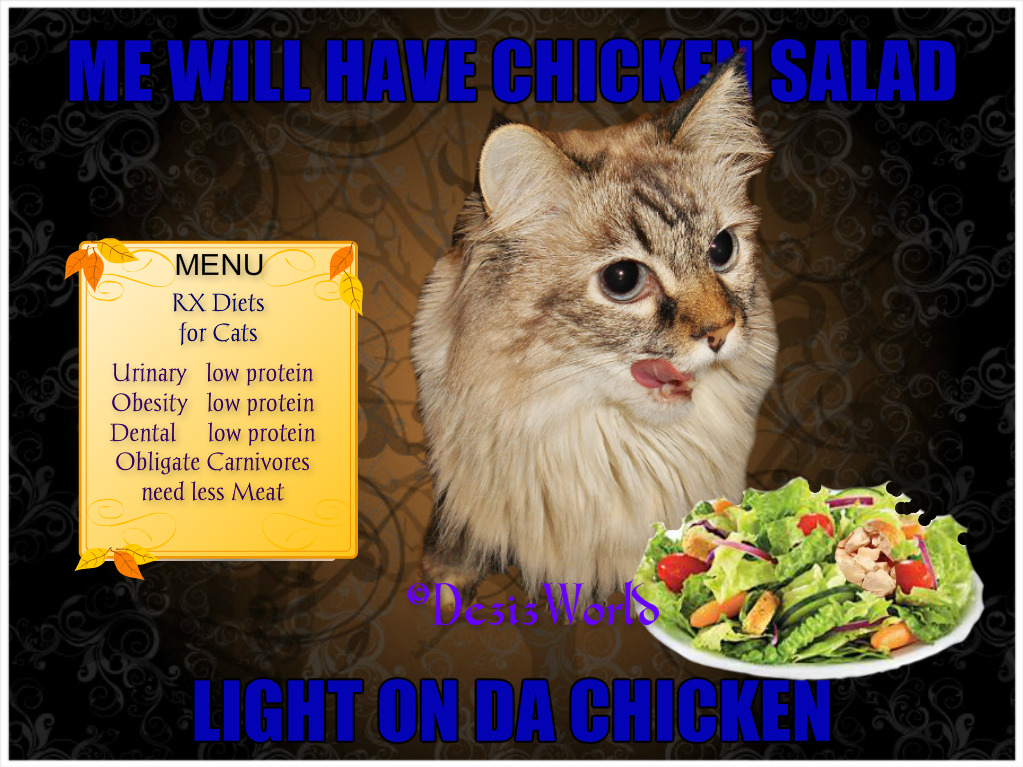
Well here we are a few weeks after meez diagnosis with Sterile Cystitis to tell ya’ da truth as we have found it. We told you then what we were told by da VET. We told you dat this was very common ‘specially among cats who eat Blue Buffalo foods and dat it was caused from too much protein in da diet. Yep we wrote it as we was told, but we also included dat mommy wuld be duin’ a lot of little research herself. Just didn’t seem right dat an obligate carnivore kuld be eatin’ too much protein?.
Meez sure glad you don’t believe everything your told mommy. Me just wuldn’t like eatin’ salads and cereals.
No sweety you sure wouldn’t have, nor could you survive on those. Quite frankly I’m sick and tired of hearing from vets and pet food companies that cats, who everybody knows are “obligate carnivores,” need less protein. And I’m tired of pet food companies including so many ingredients in their foods that cats don’t need, can’t process and that could literally kill them.
Me thinks we oughtta ‘splain what dat means. Wikipedia says Obligate means by necessity. And Carnivore means flesh (meat) eating animal. In plain human English dat means Cats MUST eat meat. So how is it dat me kuld eat too much meat?
Pull up a chair, get’cha’ a cup of joe, tea, or whatever you dwink and let mommy tell ya’ how it is.
That’s just exactly what I wanted to know baby, and one of the many reasons I like to research everything myself. And the biggest thing I found in my research was not the amount of protein in cat foods but the amount of carbohydrates. High carbs can cause inflammation in the bladder and thus bring on a bout of Cystitis. Your grain free diet was full of them as are many cat foods regardless of quality or price, grain free or not. Pet parents almost need to become scientists to understand the labels on their pets’ food. The photo on the package is rarely indicative of the actual ingredients in the bag or can of that food in your cabinet. You can read the Truth About Pet Food for more information about what’s in your pets’ food and the FDA regulations, etc. Again, there are many other places to gather this information and you need to research and decide for yourself what is fact and what is fiction.
The ingredient list of the food Dezi was eating.
Ingredients on the Hills bag the vet recommended below:
Sterile Cystitis can be called a myriad of things such as, Idiopathic Cystitis, Urinary Tract Infection, and others. Anything having to do with the lower urinary tract is put under the umbrella of Feline Lower Urinary Tract Disease. Altho’ Sterile Cystitis is NOT an infection.
Sterile Cystitis is a condition that can affect both cats and kittens, male and female alike. The first occasion of Cystitis often occurs in young cats between the ages of 2 and 6 years old. The name implies an inflammation of the bladder of unknown origin with no infection present. In other words, they don’t really know what causes it. And altho’ there’s no infection, the cat is most likely in pain.
Vets make assumptions and all too often give bad or outdated information. We were told Dezi was eating too much protein and that the prescription diets for this condition (like the one for Lexi’s CKD) had a lower protein percentage and would clear up her symptoms. And that a lifetime switch would keep it from coming back.
Another assumption is that stress is a leading factor in causing Cystitis. For cats, stress could be anything. In general (not always) cats don’t like change. They are creatures of habit. Anything out of the ordinary can stress a cat. Boredom can cause stress as much as a thunderstorm or a house full of guests.
You can find a list of “typical” symptoms all over the internet, but I will list them here as well.
1. Frequent attempts to urinate
2. Straining in the litter box
3. Crying out while in the litter box
4. Blood in the urine
5. Urinating outside the litter box
These are the main symptoms that alert to a problem in your cat or kitten’s urinary tract. BUT Dezi had none of these symptoms. Altho’ Dezi went to the litter box 4-5 times a day, she never strained or cried out and there was never blood in her urine. She wasn’t drinking excessively, altho’ she did like to play in the water fountain, thus justifying her 1-2 extra trips a day. When she did use the piddle pads instead of the box, it was always because the box had been used and not yet scooped. If she poops before urinating, she won’t go in the same box. The only time she will do both in the box at the same time is when she urinates first. Yes I know she’s got a few strange quirks, but that’s my baby girl and I love her no matter what.
So what were Dezi’s symptoms you ask? What caused me to think a urinalysis would be a good idea as it’s not really part of the complete exam the vet was offering? Well a lot of you know I lost Lucky to a urethral blockage, and Dezi was mimicking some of the behaviors that he had. So we are going to list them as well because feline health is so important and they can hide an illness so well.
1. Excessive licking/cleaning of the genitals immediately after urinating.
2. Appearance of spraying without actually spraying. Example:Tail straight up, cat backed up to wall/chair/leg/etc. and then tail shimmies/shakes with no urine produced. (This is something both Lucky and Dezi did when they got excited so I never thought it was a symptom of anything other than joy. They would both sometimes chatter at the same time. However, Dezi no longer does this regardless of her excitement level so this is a symptom of a problem).
3. Smaller than normal urine clumps.
Meez harness helps keep da stress down durin’ a funder storm.
With Sterile Cystitis there is also the possibility that crystals have formed in the urine/bladder. There are 2 main forms of crystals called Struvite and Calcium Oxylate. Since this didn’t happen in Dezi’s case we won’t go into them here, but you can read more about them at uvma.org.
With a condition that has no real explanation as to it’s cause, how do you go about treating it? Something you should be aware of is the fact that cats can have this condition and have it clear up on its’ own in a week or two with no treatment whatsoever. Since there’s no infection, antibiotics are not helpful and should be avoided so your cat doesn’t build up a tolerance. If you’ve been alerted that there’s a problem then no doubt your cat is in pain. Since the bladder is most likely inflamed, an anti-inflammatory may be prescribed for 1-3 days as well as a pain medication by your vet. If you suspect anything is wrong with your cat’s health, please see a vet immediately.
In Dezi’s case, there was no infection and no formation of crystals so after a few days of an anti-inflammatory, pain meds and an increase in hydration, she appeared to be doing better. We also began a food change as I personally didn’t like her eating the BB kibble due to the ingredients. (We’ll cover all of this in another post) We have urine pH testers on their way so that we can test her urine pH and be sure, but she is leaving larger deposits in the litter box fewer times a day now and no longer “faux spraying”. She can also leave the litter box without plopping down immediately to clean her genitals.
As you all know, I’m not a fan of prescription diets from any manufacturer since they are all based on the studies done by Hill’s Pet. Instead of doing their own research they rely on old studies performed by a food manufacturer more than a decade ago. Now having said that, you must make the decision for your own cats. I only ask that you do some research before you believe everything you’re told. Vets are an invaluable resource, but even they don’t know everything, and can’t keep up with all the new information and studies. And you know your cat better than anyone. Okay, off my soap box now and back to the known facts.
Cats don’t drink like other species so a wet diet is preferred to aid in keeping them well hydrated. Water fountains are also a good choice because cats like fresh running water. (please clean your pets’ water bowl or fountain regularly.) A batch of cooled nip tea, cooled chicken broth or a few ice cubes in your pets drinking water may also entice your cat to drink more.
We’ll be discussing Dezi’s food change and supplements in a future post as well as the stress relieving supplements and changes we are making in our everyday lives so that we can lessen the possibility of a recurrence of Sterile Cystitis or any other FLUTD’s.
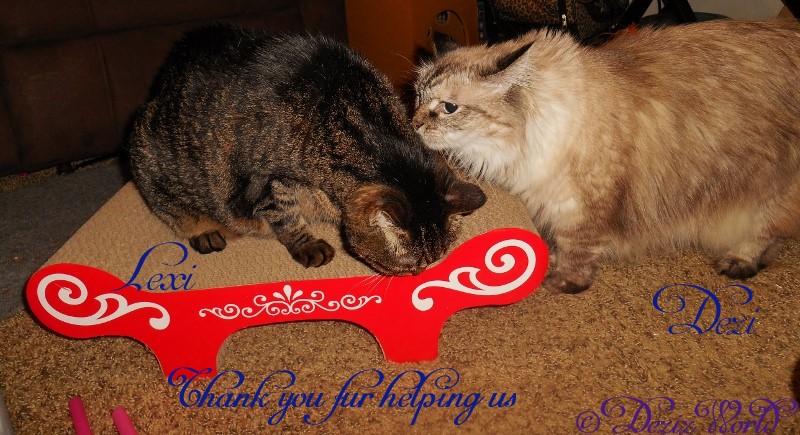
Fank you all fur helpin’ us. Our Chewy box arrived today wiff our noms, litter and pH testers.
Well mommy ifin anypawdy was wonderin’ where me got meez wordiness from, they be wonderin’ no more. MOL We know this is a long posty, but it’s full of good infurmation and in human English so it shuld be easy fur everypawdy to read. This post is in no way a comprehensive look at Sterile Cystitis, but is the truth as we have found it.








 Service Cats U.S.